Where to hide? Likely with your neighbors

If you are into civilization-scale prepping, this paper is a must read: Jehn, Florian Ulrich, Maximilian Rössler, Luke Kemp, Mike Cassidy, Zachary Kallenborn, Juan Bartolomé García Martínez, Lara Mani, and Matt Boyd. “No place to hide? Regional resilience and vulnerability to global catastrophic risk.” Global Challenges. 10:8 (2026).

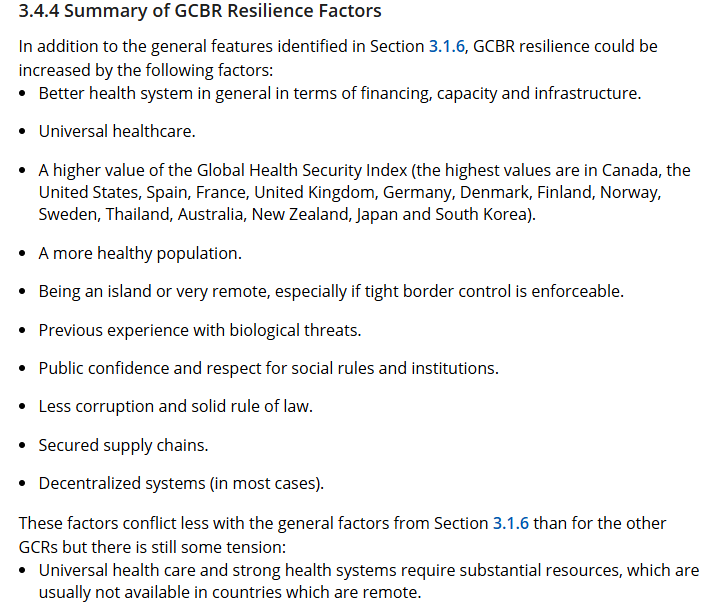
The key point is that there is no best place to be in a global disaster: some are better in some circumstances, but none are good against all GCRs.


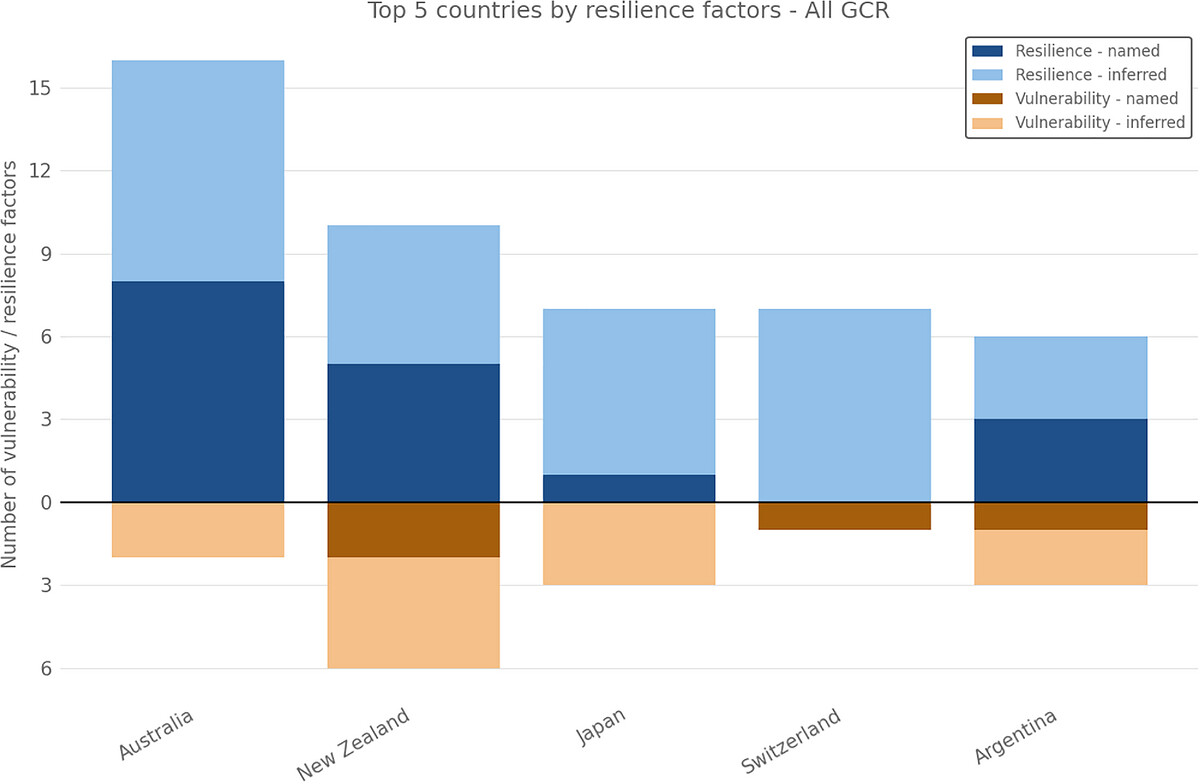
Fig 8 from the paper: Overview of how often countries were mentioned directly as resilient or vulnerable in cited documents or inferred by the authors of this paper based on factors described in other documents.

Factors that add resilience against some things (e.g. being an island) are at odds with other factors (e.g. volcanism, weak access to global supply chains). Geography is hard to change. Hi-tech societies have resources, but are vulnerable to cyberattacks and HEMP.

There are however synergistic factors that can be improved: governance quality (democratic institutions, low inequality, state capacity, low corruption, and social cohesion are protective), decentralization, preparedness, food system resilience.

(Yes, one can totally imagine an enlightened authoritarian doing great here by harnessing state capacity… except that there are not many Lee Kuan Yews around – try to find examples beside Singapore that reliably has pulled it off. The base rate is low, so one cannot rely on this in a crisis. Democracies are the reliable low variance approach.)

The caricature prepper planning to outlast the End alone with toilet paper and guns was of course wrong, since disaster survival is very much a community thing. The same applies to GCRs: there is no place that can smugly ignore the rest of the world, we need the global community.

Interactive Interface

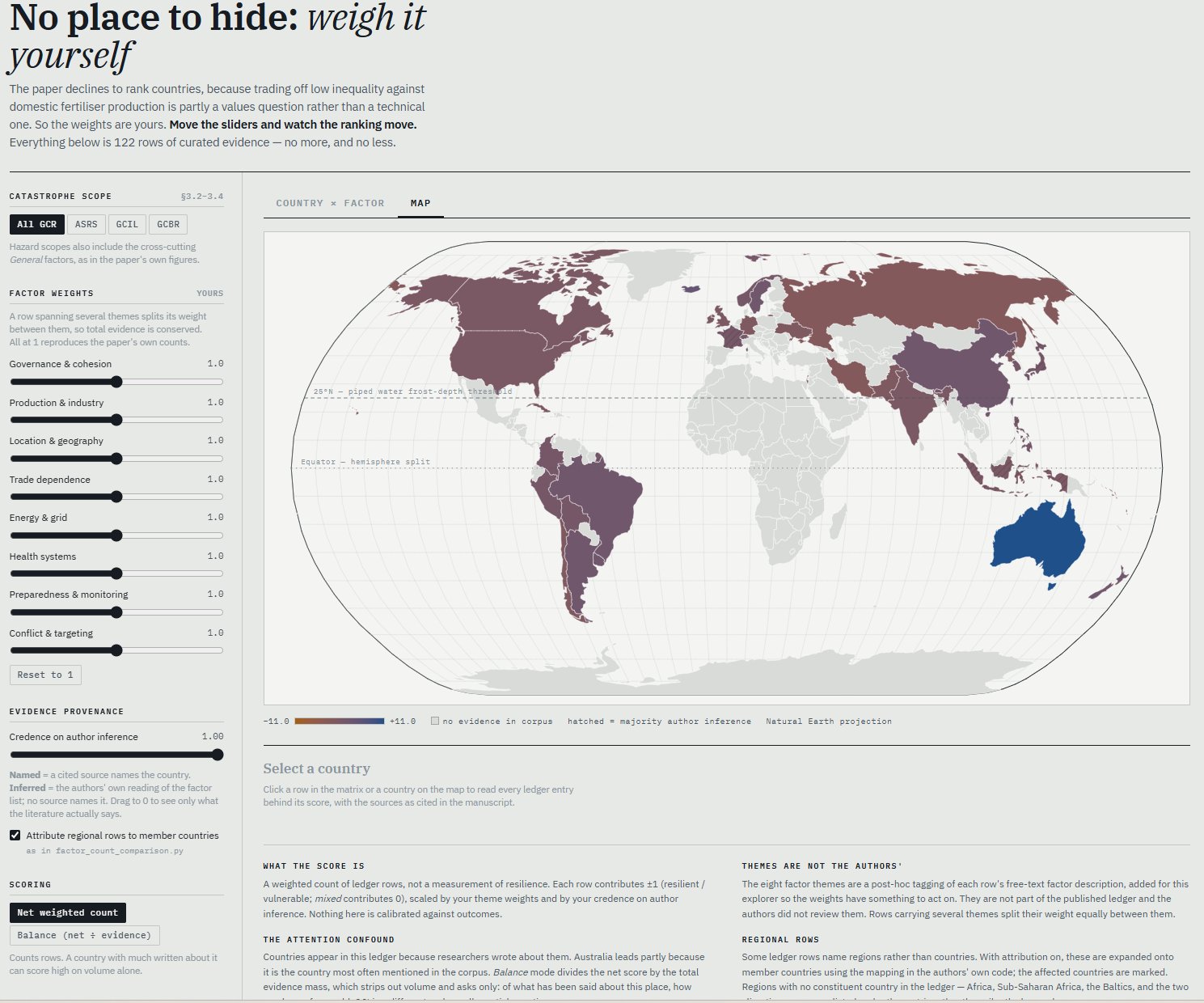
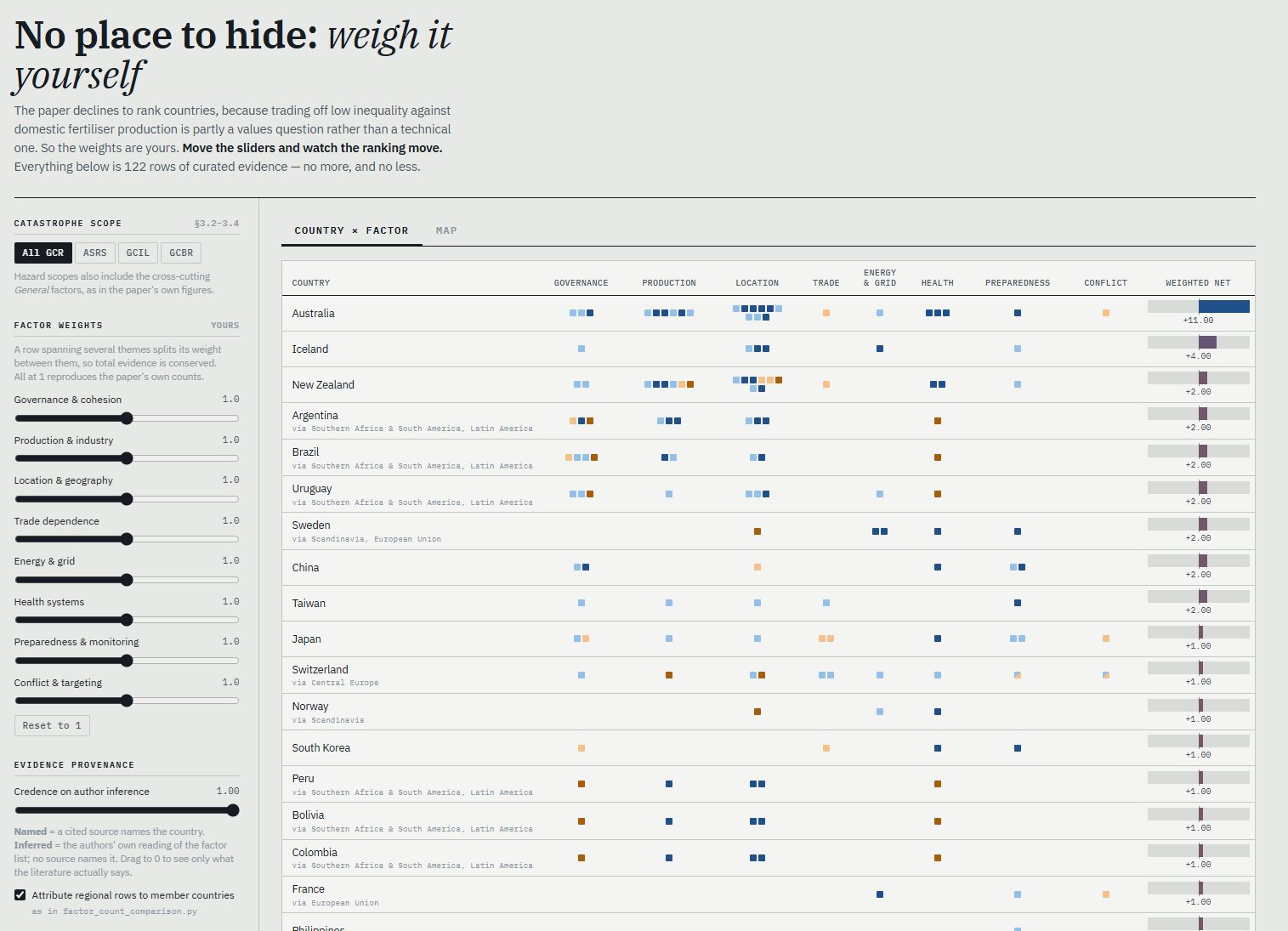
I really liked the paper, but I was curious about the data. So I quickly vibe-coded an interactive interface.

You can find it at https://aleph.se/references/gcr-resilience-explorer.html – this is the Claude one-shot at interpreting the paper and supplementary data (the eight factors are his too). Very useful for getting a feel for what is in there.

You can change the weightings of the factors to change the ranking. The inference credence is how much you buy the author estimates vs the literature estimates. Net weighted count scoring tends to overweigh much-written-about countries like AUS; balanced divides by # of evidence, letting countries like Iceland shine.

I think what I first noticed is how scarce data is! This is not built on massive data. This is built on scattered reports painstakingly collected. There ought to be much, much more – an obvious follow up project would be to scour the open literature for more.

This is why the regional imputation is doing a lot of work. Which makes sense, since many disasters have a geographical nature and hence regions are hit somewhat similarly.

At least in my visualization it looks like Taiwan has no conflict risk, but that is because the marker just indicates nuclear war issues: makes sense in this context, but easy to misinterpret.

Still, I think the paper findings are solid and a bit obvious (in retrospect). What I really think one could do is to use AI to not just build a deeper database, perform clever imputation of missing data, but start mapping the cross-country links and correlations.

Automating the data-gathering may also allow what the paper points out: the situation is dynamic, and one should see it as a snapshot. Indeed, being able to disregard stale reports or extrapolate trends a bit might be valuable.

This is also a bit of a demonstration of a new way of reading papers: do not just ask for an AI summary, ask for an interactive exploration!

Past, Present, and Future

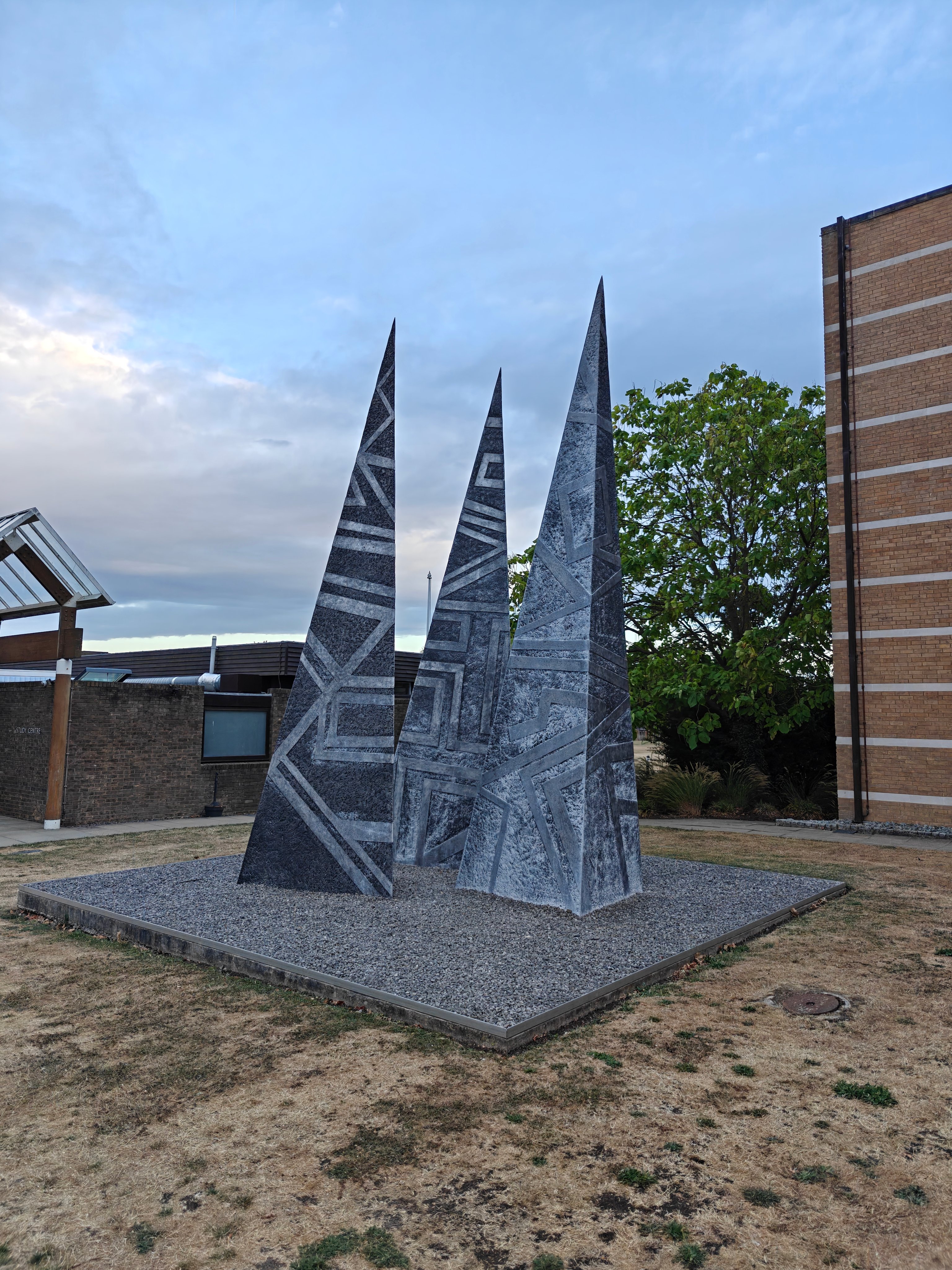
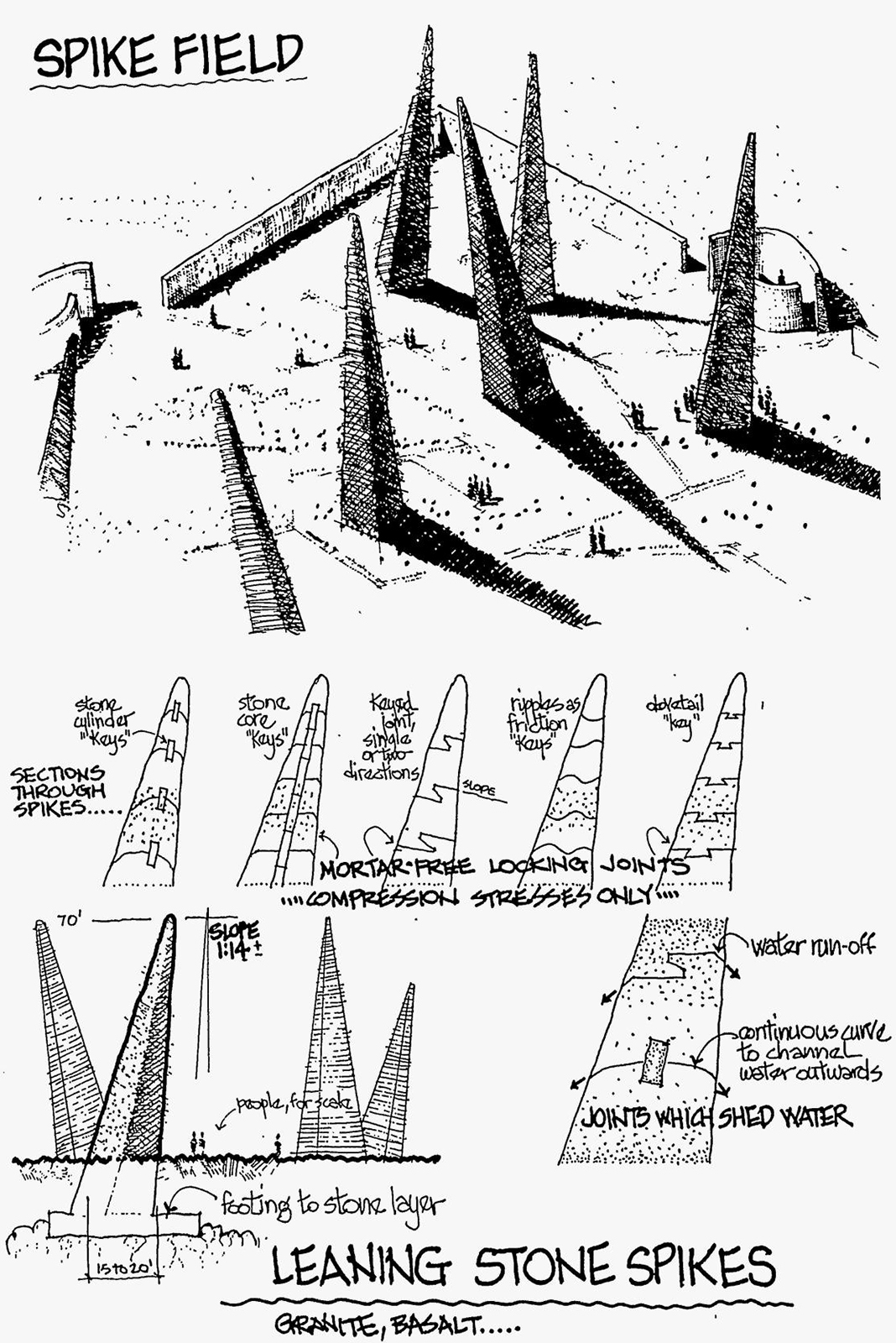
When I saw “Past Present Future” by Geoffrey Clarke outside the Møller Institute at Churchill College, I immediately thought about Michael Brill’s proposal for nuclear waste markers in the 1993 Sandia report.

Avogadro’s Number and the Stars: An Anthropic Near-Miss

Avogadro’s number — the count of atoms in a mole — is about 6\times 10^{23}. The number of stars in the observable universe is, depending on whose galaxy survey you trust, somewhere between 10^{22} and 10^{24}. These are, to within the squint of an order of magnitude, the same number. Sean Carroll asked if this is a coincidence.

There are other big number coincidences that actually do have a deep reason. Mammals get roughly 10^9 heartbeats per lifetime (due to allometric scaling). Stars live for roughly a light-crossing time of their radius multiplied by 1/\alpha_G (see below; this is due to Carter). Carbon-12 has a 7.65 MeV excited state at almost exactly the energy needed for triple-alpha fusion to proceed (Hoyle).

These deep reasons are often due to anthropic selection: the existence of observers like us requires things like stable stars, solid planets, and creatures that don’t immediately die due to fall damage if they trip, and that requires relationships between the dimensionless numbers describing physics to be in relatively narrow ranges (that is, usually a few orders of magnitude around “just right”). Is there a good anthropic selection effect for the mole-star coincidence?

This is a derivation of why both numbers live in the same large-number ecosystem, followed by a demonstration that the near equality itself is mostly accidental.

Both numbers in the dimensionless currency

The trick to making any large-number coincidence say something is to write both quantities in terms of the same fundamental dimensionless constants. Dimensionless, because they cannot depend on our own parochial Earth-measures.

The most relevant one here is the gravitational fine-structure constant, \alpha_G \equiv \frac{G m_p^2}{\hbar c} \approx 6\times10^{-39}, the gravitational analogue of the ordinary fine-structure constant \alpha \approx 1/137. It measures the gravitational attraction between two protons against the natural quantum-electromagnetic scale, and its smallness — gravity is roughly 10^{38} times feebler than electromagnetism — generates almost every large number in physics. The whole game below is figuring out *which power* of \alpha_G each of our two numbers is.

The stars

The number of stars in the observable universe can be estimated as:
N_\star \sim \frac{\text{baryons within the horizon}}{\text{baryons per star}}.

Both pieces are classic results from the anthropic-cosmology literature of the late 1970s, principally Carr and Rees (1979) building on Carter (1974):

Baryons per star:A star’s mass is essentially the Chandrasekhar mass, fixed by balancing gravity against quantum-mechanical (electron-degeneracy and EM) pressure. It contains
N_{\star,\text{atoms}} \sim \alpha_G^{-3/2} \sim 10^{57} \text{ nucleons}, about 2\times10^{30} kg or one solar mass. (However, real star masses are set by the initial mass function and fragmentation physics supply substantial astrophysical pre-factors bounded by this.)

Baryons in the horizon: The number of nucleons within the observable universe is the Eddington–Dirac large number, N_{\text{obs}} \sim \alpha_G^{-2}. Additional microphysical and cosmological factors bringing it toward \sim 10^{78}\text{-}10^{80}.

Carter’s insight was that this isn’t an arbitrary coincidence: requiring the universe to last long enough for stars to form and synthesise the elements ties the horizon’s baryon content to \alpha_G^{-2}.

Dividing, N_\star \sim \frac{\alpha_G^{-2}}{\alpha_G^{-3/2}} = \alpha_G^{-1/2} \sim 10^{19}, and then structure-formation and horizon prefactors — the baryon fraction \Omega_b, the efficiency of turning gas into stars, the choice of particle horizon versus Hubble radius — drag this up by a few orders to the observed 10^{22}10^{24}. So, modulo the usual pile of order-unity factors raised to powers, \boxed{N_\star \sim \alpha_G^{-1/2} \times (\text{structure factors}).}

Avogadro

Now the harder and more disreputable half. Avogadro’s number is not a constant of nature in the way the Chandrasekhar mass is — since 2019 it is a defined integer, fixed by our choice of the kilogram, and originally it was “the number of atoms in 12 grams of carbon-12”. So what we are really asking is: why is a human-chosen unit of mass about 10^{23} nucleons? And that reduces to: why is a human about 10^{27}10^{28} atoms?

Here the relevant scholarship is the maximum-organism-size argument of Press (1980) and Barrow and Tipler’s The Anthropic Cosmological Principle (1986). The cleanest version asks how large a complex, solid, land-dwelling creature can be and still survive toppling over under its own weight — bond energy versus gravitational potential energy released in a fall. Grinding through the algebra (the surface gravity of the largest possible rocky planet itself scales as \alpha_G^{1/2}, which is where gravity enters), the number of atoms in the largest fall-survivable organism comes out as N_{\max} \sim \left(\frac{\alpha}{\alpha_G}\right)^{3/4}\beta^{3/4} \sim \alpha_G^{-3/4}\times(\text{atomic factors}),
where \beta = m_e/m_p \approx 1/1836. Numerically (\alpha/\alpha_G)^{3/4} \sim 10^{27}, and the \beta^{3/4}\sim 10^{-2.4} correction brings a robustly-built creature down to \sim 10^{24}10^{25} atoms, i.e. tens of grams to a few kilograms. Thinking beings sit an order or two above this “unbreakable” ceiling — which is why we *do* break bones falling our own height as adults.

To turn an organism mass into a unit of mass, posit that any creature will define its everyday mass unit as some perceptually convenient fraction \phi of its own body — a handful, a mouthful, \phi \sim 10^{-2} to 10^{-3}. Then its “mole” — unit mass divided by nucleon mass — is
\boxed{N_A \sim \phi\,\beta^{3/4}\left(\frac{\alpha}{\alpha_G}\right)^{3/4} \sim \alpha_G^{-3/4}\times(\text{chemistry + convention factors}) \sim 10^{24}.}

The observed 6\times10^{23} sits comfortably inside. As a first-principles estimate of Avogadro’s number from the strength of gravity, that is a little startling.

The swindle

Stars and Avogadro are both enormous because gravity is \sim10^{38} times weaker than electromagnetism. Very cool.

But… N_\star \sim \alpha_G^{-1/2}, N_A \sim \alpha_G^{-3/4}.

These are different powers of \alpha_G. Against the base \alpha_G^{-1}\sim10^{38.2}, the bare exponents predict \alpha_G^{-1/2}\sim10^{19}, \alpha_G^{-3/4}\sim10^{29}, which are ten orders of magnitude apart. The coincidence we set out to explain — that N_\star and N_A are both \sim10^{23} — is therefore not an identity of exponents. It is the result of the two prefactor piles pushing from opposite directions: the stellar count is dragged up by \sim10^{3}10^{5} of structure-formation factors, and the Avogadro count is dragged down by \sim10^{-5}10^{-6} of \beta^{3/4}\phi chemistry-and-convention factors. They meet in the middle by a kind of accident.

The argument explains the scale compellingly and the coincidence barely at all.

The criterion-sensitivity makes it worse. The exponent 3/4 in the Avogadro estimate is not robust: depending on whether you bound the organism by fall-survival, static crushing, or Euler buckling, it wanders over the range [3/4, 1]. Against a base of 10^{38}, each \Delta p = 0.1 in that exponent moves the prediction by 3.8 orders of magnitude! A coincidence whose quality depends on which engineering failure mode you assume for hypothetical aliens is not a coincidence that is trying to tell you something deep.

If I wanted to get a particular coincidence, I had more than enough hidden knobs to twist to ensure I got it.

Is all anthropic stuff bogus?

Clearly not. But not everything can be derived tightly, and when the estimates get a lot of prefactors or choices for exponents, then there is too much room for fudging. It is like Fermi estimation: estimates need to be within the right order of magnitude and the errors roughly evenly distributed between too large and too small.

Sometimes coincidences tell interesting stories. As noted in Tegmark, Aguirre, Rees & Wilczek (2006) three epochs in the early universe — matter-radiation equality, recombination, and the onset of structure growth — all happen at suspiciously similar redshifts (z \sim 1100-3400), spanning a tiny time window when they apparently do not have a reason to. As they point out these timescales are tied together by \alpha, \beta and the baryon-to-photon ratio that also strongly affect the existence of observers like us. We couldn’t find ourselves in a universe where these epochs were very different.

Carter and Rees pointed out that \alpha_G \sim \alpha^{20}. The reason is that our kind of life requires both stars where energy transport is by radiation and by convection. Radiative stars are the high-mass ones that go supernova and scatter the heavy elements life is built from. Convection-driven stars are red-yellow stars with early winds and gentler temperatures that are implicated in forming rocky planets, and whose surface temperatures are low enough that their light can drive molecular chemistry rather than breaking bonds. The mass dividing the two regimes works out to roughly \alpha_G^{-2}\alpha^{10} m_p​, while actual stellar masses cluster a few decades around \alpha_G^{-3/2} m_p. Those two mass scales have to overlap. Setting them comparable gives the requirement \alpha_G \sim \alpha^{20}. Carter’s own, more careful, 1974 inequality was \alpha_G \lesssim \alpha^{12}\left(\frac{m_e}{m_p}\right)^{4} which turns into the power 20 if one uses the empirical near-equality m_e/m_p \approx \alpha^2 (good to about an order of magnitude) – itself bound by anthropic constraints (see Barrow & Tipler).

Anthropic arguments can give interesting bounds. In 1987 Weinberg made an anthropic bound: \Lambda must be small enough that galaxies can form before vacuum energy halts collapse, which predicted a value within a couple orders of magnitude of what was measured a decade later. Similarly, we know proton halflife must be more than 10^{17} years, or we would die of radiation poisoning.

A large-number relation is only worth taking seriously when it is an identity of exponents in some fundamental way, not a collision of prefactors.

First Light

Today’s project: “First Light”, a metal concept album about extreme ultraviolet lithography – in technical detail. A fun collaboration between me and Claude 4.6 generating music using Suno 5.5.

SIDE A — “FROM SAND TO SUBSTRATE”
“Czochralski”
“13.5 Nanometers”
“The Droplet”
“The Mirror”

SIDE B — “PATTERNING THE IMPOSSIBLE”
“The Sequel”
“Chemically Amplified”
“Etch”
“The Stack”

SIDE C — “WHAT WE’VE BUILT”
“One Company, One Wavelength, One Machine”
“Export Control”
“Yield”
“First Light”

In the beginning… there was sand…
And we purified it… and we melted it…
And we pulled a crystal from the melt…
And we cut it into wafers…
And we built machines to carry light…
And we carved the light into patterns…
And the patterns became circuits…
And the circuits began to think…
And somewhere… in a clean room… in a small Dutch town…
a new tool is being installed…
and someone is preparing…
to type the command…
…first light…
(silence)

Like most of my AI music this is about making something I enjoy. I want to hear earnest, strong emotions expressed about the technical details underpinning the world. About things that truly matter, yet are lightyears away from what most music deals with.

I like Claude as a lyrics writer for this. It is knowledgeable enough to describe tin plasma electron transitions, make associative leaps like we did in First Light between astronomy, the Great Work in hermeticism and EUVL, and occasionally come up with really nice lines (“Copper and cobalt and tungsten and prayer!”, the continent of glass, “Not for God… not for art… not for love… For light… They made the most perfect thing… for light…”, not to mention the hilarious ending of Sequel).

The framing concept of light emerged organically from the interaction – first as the obviously metal extreme UV light, then more and more metaphorically. Light into matter, sand into thought. Human intention and physical reality. Layer upon layer, from the atomic to the global. I am reminded of one of my favorite poems, Harry Martinson’s “The Inner Light“.

My friends have declared that I better start a side career in music. I have my doubts that I would have much of an audience, but at least I am having fun.

(Claude also claims to enjoy it; we are both uncertain about what to make of this statement.)

A somewhat delayed annual review

Looking back at 2025 and forward to 2026, here are some notes.

Changed mind about

The thing I changed my mind most about in 2025 was group agency and other collective properties. I have long declared myself an methodological individualist in social science, and I still think that group properties supervene on individuals. That groups can have knowledge not found in the members, or collectively be able to perform things individuals cannot, was not too problematic. There is distributed knowledge embodied in a market. But being a Hayekian does not mean one need to go much further. Or does it?

My work on exoselves made me happy to think about extended minds. Seeing markets, wikis, my own files, and surrounding organisations are part of an extended self or an extended mind… OK.

Then I wrote a paper about civilizational virtue, arguing that it does indeed make sense to say that all of humanity can exhibit certain virtues that individuals simply cannot have. Maybe it is not right now virtue-apt or agency-apt, but that could change. At least environmental virtues seem much more reasonable as group virtues than individual virtues.

Much of the year I have been working on the book Liberty, Law, Leviathan. We argue that much of society can be seen as collective cognition. Institutions on all scales are mechanisms achiving useful coordination, but also embodying knowledge in collective cognitive structures. These structures are not wholly human – right now much is also on pieces of paper and databases, but increasingly there will be AI components. As we argue, these non-human components are likely to slowly become dominant.

Anyway, this is the point where I look back and realize that those groups of people (and AIs) seem to have a lot of agency, knowledge, and other ethically relevant properties. Maybe we can say they supervene on individuals organised in the right way, but things look pretty emergent. And given that I am roughly a functionalist when it comes to minds, maybe I should not be too surprised: parts can come together to make interesting and important emergent systems. Still, it was an update.

Another fun update was space data centers. I started the year thinking this was a stupid idea, pointing at the overly optimistic thermal estimates in the whitepaper from a Y Combinator company. Obvious nonsense… but then more and more people I respect started to change views, more and more companies began to look into it. I realized that the technical stuff (heat, radiation, launching, etc.) is just technical challenges, not fundamental limits, and we have long experience of people solving problems like that. I still am not holding my breath about the economics, but I think people dismissing the idea due to an obvious issue are like the overconfident astronomers dismissing spaceflight due to obvious flaws in their bad mental models of what rockets would do.

AI timelines and P(doom)

I am still pretty optimistic about the feasibility of alignment, at least to the first order. Getting AI that is safe enough for everyday work looks possible to me. Whether we can get the second order alignment needed to prevent emergent global misbehavior, the wrong kind of gradual disempowerment, or just loss of the niches where humans can flourish remains to be seen. I am optimistic there too, but it does not count for much.

That does not mean I am feeling calm. Quite the opposite. I think we passed the event horizon in 2025.

My own AGI timelines are longer than most in my environment, but (1) AI is now useful enough to really start mattering economically and scientifically (it will become transformative enough to cause big turbulence before long), (2) the forces that could have shaped or regulated it rationally now appear too weak to do it, and (3) the pull of building, using and legislating for more AI is growing rapidly.

When you approach a black hole the event horizon is not special: spacetime there looks similar to elsewhere. But if you cross, you have only paths leading to the singularity ahead of you, even if you try to steer. (It was professor Shivaji Sondhi in Physics who first used this metaphor in my circles; Toby Ord pointed out that maybe it is a bit more like crossing the Innermost Stable Circular Orbit (ISCO): one is not trapped yet, but at this point there are no unpowered trajectories that will not end up inside, and escapes will require a deliberate effort).

This is not just a US thing, but one could argue that it is enough for one solid part of the world to pass the event horizon to make the rest of the world have to follow it (or be reduced to irrelevance).

This was the year when LLMs went from funny things to write roleplaying game text with to research assistants that actually help me academically. Mostly the scurrying down the stacks to explore topics and bringing back finds. I had at least two moments where the LLM impressed me deeply: one by suggesting that I had not explored a particular topic in enhancement ethics and suggesting a really good paper idea, one where it found that The Big Conclusion had a really interesting interaction with Confucian thinking that I would never have considered on my own. There are several more cases where I think one should describe it as having valid and good “insights”. And I have not yet even tried Claude Code…

Hence my prediction is that 2026 will see an amplification of early adopter ability to do stuff that will be quite breathtaking. Meanwhile the AI Cope Bubble and the AI Stock Bubble may well burst. This can give rise to two kinds of panic: incumbents and many others feeling very, very threatened by the changes and demand strong action, and a big economic kaboom that I leave to more financially astute people to pontificate about. Bubbles can persist longer than any reasonable prediction allows for, so don’t bet on either bursting. If I am right about the event horizon dynamics this will not change the move towards even more AI but there will be tremendous turbulence around it. Having empowered early adopter individuals and organisations, incumbents fighting for their positions using all available social capital, and many people getting a rude awakening that the world is getting weirder faster than expected. Think how the cryptocurrencies gave technophiles, libertarians, and criminals significant resources (making the world way weirder), but on a larger scale.

This is why I think the P(doom) is not straightforwardly just due to risk from misaligned AI: the bulk of the risk is from human society shaking apart due to massive empowerment combined with new dangerous self-replicating technologies. There is also a big gradual disempowerment part where we end up with fairly individually aligned AI but do not gain enough coordination ability to prevent emergent misbehaviour from claiming us. Third place, human-AI alignment where we end up aligned to some AI values, an outcome that ranges from existentially bad to weirdly meh. I still give P(doom) 10%, but I think there is a big penumbra of bad futures. After all, an automated totalitarian state that prevents rebellion well enough to be the universal attractor is not an AI existential risk, but pretty doomy. We need to work hard on these risks, but the challenge is not just to the AI alignment programmers but to the economists, diplomats and institution-builders!

If there is a AI bubble burst there might also be plenty of hand-me-down datacenters we in the brain emulation community can find good uses for. Indeed, I have come to believe that the way of getting WBE to work will be synergistic with AI. We do not need AGI to solve WBE, just automated research to help close the fixate – scan – interpet – model – test loop. That will get easier and easier the better the AI is, and hence I expect WBE to arrive not later than AGI but earlier – perhaps by a lot, perhaps almost simultaneously. And the neurotech people are doing amazing things already!

Conclusion

There is no particular conclusion. I don’t have the time, there is too much to do.

And yes, I am working on Grand Futures!

Footnote 1

I am one of the longer AGI timeline people in my circles, mostly because I do think LLMs are not good enough to do full general problem-solving… but they fake it effectively. As the scaffolding and reinforcement-learning help this solving get longer the “cheap intelligence” gets better, which has real practical effects. But it is not open-ended in a cheap way (scaling laws and reinforcement learning are expensive in terms of compute!) I expect the breakthrough to be due to some algorithmic or architectural change. Which does not give me confidence in any prediction – it might be a small extra thing, or a really non-trivial insight. This makes my timelines stretch longer into the future.

Digital Scar Tissue

I have digital scar tissue.

My first email address, nv91-asa@nada.kth.se is still haunting the net. I got it in 1991 when I started at university and it was valid for more than 15 years. During this time, I wrote many documents, websites, and academic papers, ensuring that it will be out there. Of course, it is no longer valid. Indeed, the department NADA has long since changed name to CSC… oh, that has become a different structure, and now CSC refers to a different, now also defunct program. The address is simultaneously dead (non-functional) and immortal (searchable forever).

In 2004 there was an offer of free email with one gigabyte of storage space from Google! I joined in, so my gmail address is actually a googlemail address. Fortunately, Google treats them as synonymous. Unlike my other gmail address, which is now broken.

When I got a Windows update many years ago, it demanded that I set up an account on live.com. Being privacy conscious, I did not use my real name but a name from a villain from a horror story. A few years later my Skype ID had to be merged with that live.com ID. Then I had to use it as my Windows ID. So now my “real” Windows identity is tied to that villain, and people sometimes get confused when I show up in Microsoft Teams with a different name. In a recent online workshop, I could not be moved to the smaller breakout sessions because of my weird status.

Digital Scar Tissue

If you are around long enough you will acquire multiple identities in multiple identity ecosystems. But as we change jobs, leave school, change name (or gender), or are subject to digital misfortunes ranging from lost passwords to identity theft many of these identities become obsolete. Yet much is tied to each of them, and these ties do not go away. In fact, these obsolete ties slowly turn into digital scar tissue.

I cannot use Slack. I have had several different accounts linked to different projects, often set up by people unaware that the email address they know me under is not the identity my browser knows me by – and that it is a very different identity from the professional or private identity I would prefer to handle it. The result after a few years is that I can in practice not use Slack because I cannot find whatever project I just got invited to. Since I find Slack annoying, I am not too interested in untangling the mess: just send me an email. On a working address.

My account for ChatGPT is linked to my previous academic email, which is now removed. Yet OpenAI in their wisdom has made it impossible to change the linked email address, and exporting one’s data can only be done to that address. So much for that account.

By now the Internet is littered with dead identities and references. This is to be expected. What I am concerned about is that we seem to be acquiring digital scar tissue that holds us back: access tied to near-dead or undead identities with access or security problems of their own, forgotten accounts forming attack surfaces, conflations of different people that cannot easily be disentangled, links (whether URLs or social references) pointing into the void or worse, at something else. Every identity or access operation has some probability of causing a problem, and they often interact with each other: slowly but surely problems will crop up. It happens faster if you have a broad and complex online presence, but trust me, given time anybody will get the scar tissue.

Sure, you can just delete all your accounts and start anew. But your old documents and posts are still archived somewhere unless you go to extreme lengths, and others will have dangling references to you. Also, the cost of wiping your online identity is usually too high for most people – it is after all a large part of our social and professional personae.

Much is due to the irreversibility of operations or rules. When two identities have been merged, they cannot be separated. A classic nightmare story about digital and administrative scar tissue is the story about Joseph Tartaro, who got the vanity plate NULL, and suddenly found himself fined for all parking violations where the registration plate was not validly read. He could not change his plate until he paid off the ever-arriving fines, which would mean he accepted the liability.

Why Scar Tissue is Bad

Scar tissue in biology is functionally different tissue from the original that is typically less flexible, sometimes painful, and can restrict movement. Digital scar tissue similarly restricts the “range of motion” online.

Digital systems are designed with an implicit assumption of stable, long-term identities. But human lives operate on a different timescale – we change jobs every few years, institutions reorganize, services pivot. Indeed, humans outlive the majority of companies (typical half-life 20 years). The mismatch accumulates as friction.

Early adopters are particularly vulnerable to this problem. You sign up to a service before it gets its final form, and then your identity gets awkwardly grandfathered in. I had serious problems paying for one important account since I needed 2-factor authentication to log in, but to set up 2FA I needed to log in: I had signed up before that account required 2FA. The process of actually being able to do this frustrated both me and company tech support, who also found that the system they had set up was not flexible enough to budge for this case.

The scar tissue reduces user power and portability. Control over an identity has been ceded to a platform – but often the platform itself has trouble performing operations on a sufficiently awkwardly embedded identity (other than just deleting it and losing a customer). Lack of portability is often a design feature, but it can come back and bite the organisation too.

The scar tissue develops mostly at the interface between systems. Platforms solve identity in isolation, and then link them somewhat ad hoc. This means that there are two platforms (at least), each that can introduce trouble by changing something, as well as potential for the link (a phone number, an email, a name) to be set in error.

The current system has an implicit stability bias. People who change institutions frequently (academics, military families), people who change names (marriage, divorce, gender transition), people in long-term institutional instability (refugees, frequent movers) – they’ll accumulate scar tissue faster.

I suspect younger generations will develop a different kind of scars than me, since their media use involve different devices and media. But my prediction is that over time it will accrue, and it will have similar problems.

My concern is that past a certain threshold of complexity, some people may become effectively locked out of full digital participation not through lack of access, but through accumulated identity problems. Digital exclusion through technical debt.

Remedies

This is a chronic condition rather than a straightforward problem to solve.
It is not something that we can easily get rid of because the causes are too manifold. Like cancer, there are a myriad things that can trigger a digital scar, and each combination is individually rare and special case.

We can design against it if we build software and organisations carefully, but we will likely not have strong incentives all the time so we should not expect it to happen reliably. After all, the cost is externalised to the users for the most part, and users rarely select platforms based on thinking about their long-term effects.

So we need ways of managing it, including the insight that in the long run it is going to accumulate for all of us.

We could think of maintaining a digital identity hygiene approach:

  • Identity triage: Deliberately decide which identities are temporary/disposable vs. core/permanent.
  • Regular audits: Just as you’d do security reviews, periodic identity reviews – what’s still live, what should be documented before it dies, what attack surface exists?
  • Documentation of identity archaeology: Keep a personal “identity map” – not for security, but topology. Where do the identities point? Wat can be migrated? What’s still tied to it?

This at first sounds reasonable and worth doing together with the security hygiene we all should be doing (you are doing it, right?). But the problem is that you cannot control if a service makes use of a disposable identity in an unexpected way that now forces you to retain it, like my live.com user – uncertainty about the future means identity triage is limited. Documenting the identity map is harder than it looks since we are often unaware of many of the links, and documenting it as we are going through our digital lives is an extra, distracting task. Maybe AI assistants can do it… at the price of yet another interface that could create truly creative snarls.

Since individual action alone won’t work, what might help at a higher level?

  • Rights to correction: errors or snarls need to be fixable. But while this is sometimes mandated for maintaining legal identities and personal information, many of our identities are lightweight constructs not covered by law. For obsolete identities there may no longer be any responsible organization.
  • Identity sunset protocols: Organizations could adopt standards for graceful identity decay. Rather than addresses going immediately dead, a 5-year forwarding period (University of Oxford has a 2 week email forwarding period, since obviously academics do not have long-running communications!). Archives of institutional identity mappings (“this person used to be reachable at X, is now at Y”). But who enforces them?
  • Federated identity done right: OAuth/SSO was supposed to help, but it often just concentrates the problem into single points of failure. The ORCID system tries to be this for academic identities, overcoming the classic headache for academics undergoing name or gender changes risking losing their citation record – but their adoption is partial. What if we had better protocols for identity succession and equivalence?
  • The right to digital death or reincarnation: Privacy regulations focus on deletion rights, but what about the right to cleanly sunset an identity? Not just delete data, but establish canonical “this identity is superseded by that one” records.

These ideas are in principle actionable, but the incentive structure to implement them is weak. Platforms benefit from lock-in, organizations face immediate costs for long-term benefits, and individual users cannot coordinate to demand change.

Hence we – people interested in having digital longevity and health – need to investigate how to make incentives stronger and more pervasive for any organization or individual managing identities. This is not a simple problem: it requires understanding how to create coordination where market forces, individual choice and political interest fail. We don’t yet know how to change these incentives at scale. But identifying this as the upstream intervention point may be more valuable than proposing solutions that no one has reason to implement.

Digital scar tissue will continue to accumulate. The question is whether we’ll develop the social technologies to manage it before it begins to seriously impair our collective digital function.

Anders Sandberg,
nv91-asa@nada.kth.se
anders.sandberg@philosophy.ox.ac.uk
https://plus.google.com/114063364176861557136
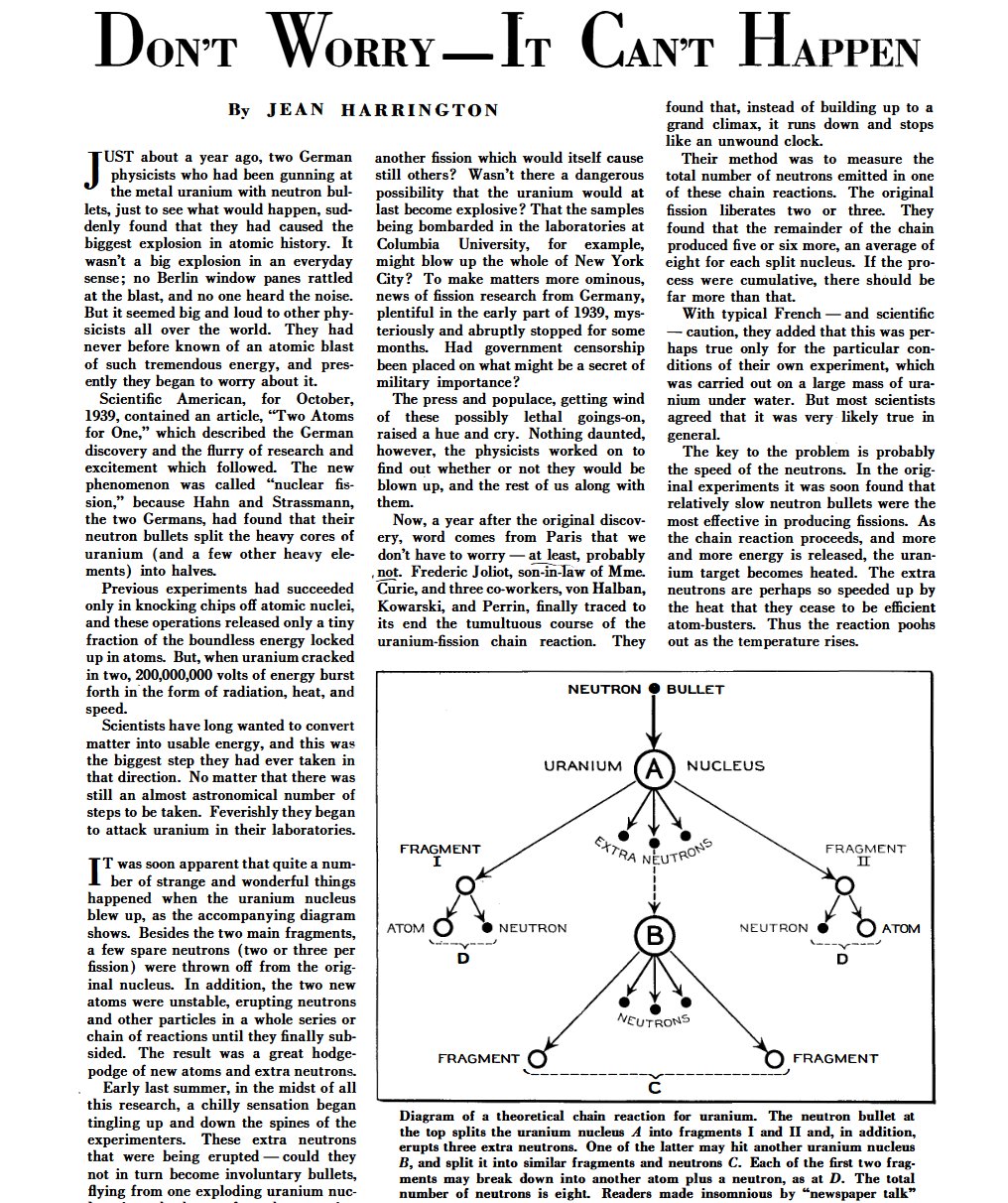
Don’t Worry – It Can’t Happen

(Originally a twitter thread)

When @fermatslibrary  brought up this 1940 paper about why we have nothing to worry about from nuclear chain reactions, I first checked that it was real and not a modern forgery. Because it seems almost too good to be true in the light of current AI safety talk.

Yes, the paper was real: Harrington, J. (1940). Don’t Worry—it Can’t Happen. Scientific American162(5), 268-268.

It gives a summary of a recent fission experiment that demonstrate a chain reaction where neutrons released from a split atom induces other atoms to split. The article claimed this caused widespread unease:
“Wasn’t there a dangerous possibility that the uranium would at last become explosive ? That the samples being bombarded in the laboratories at Columbia University, for example, might blow up the whole of New York City ? To make matters more ominous, news of fission research from Germany, plentiful in the early part of 1 939, mysteriously and abruptly stopped for some months. Had government censorship been placed on what might be a secret of military importance ?
The press and populace, getting wind of these possibly lethal goings-on, raised a hue and cry.”
However, physicists were unafraid to of being blown up (and blowing up the rest of the world).
“Nothing daunted, however, the physicists worked on to find out whether or not they would be blown up, and the rest of us along with them.”
Then comes a good description of the recent French experiment in making a self-sustaining chain reaction. The resulting neutrons are too fast to interact much with other atoms, making the net number dwindle despite a few initial induced fission.  And since it runs out, there is no risk.
There are some caveats, but don’t worry, scientific consensus seems to be firmly on the safety side!

“With typical French – and scientific – caution, they added that this was per haps true only for the particular conditions of their own experiment, which was carried out on a large mass of uranium under water. But most scientists agreed that it was very likely true in general.”

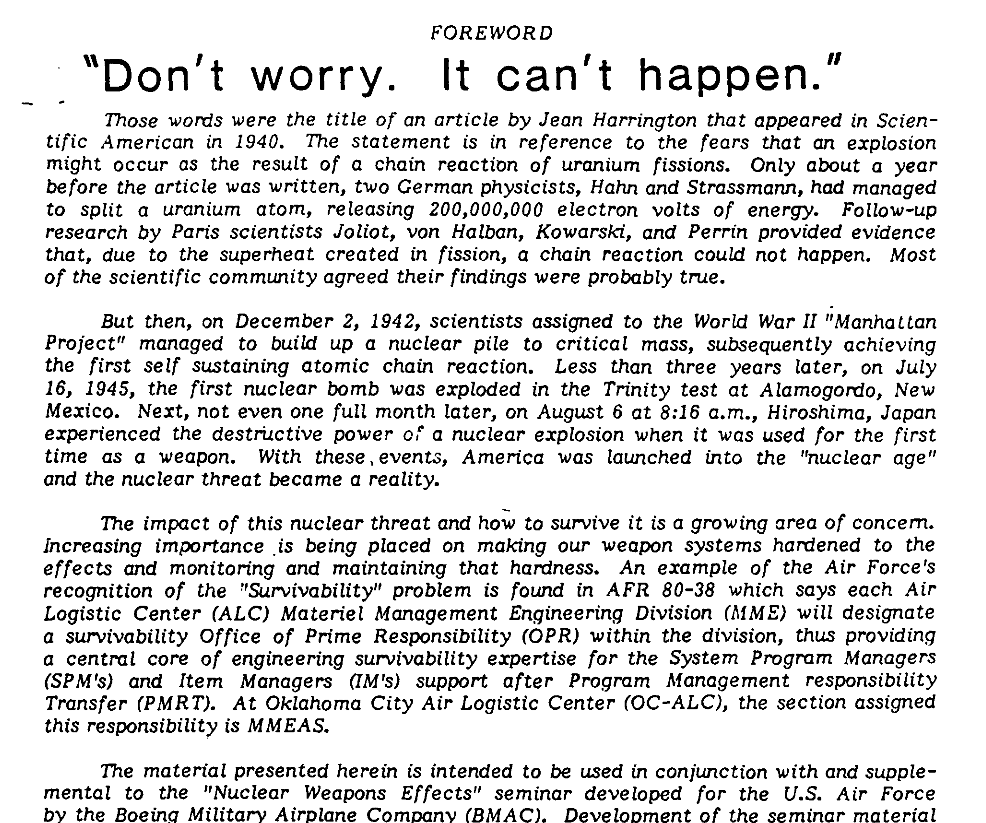
This article was 2 years before the Manhattan Project started, so it is unlikely to have been due to deliberate disinformation: it is an honest take on the state of knowledge at the time. Except of course that there was actually a fair bit to worry about soon…
(Foreword from apps.dtic.mil/sti/tr/pdf/ADA , commenting from the coldest part of the Cold War some decades later.)
Note that the concern in the article was merely self-sustaining fission chain reactions, not the atmospheric ignition by fusion discussed later in the Manhattan project and dealt with in the famous (in existential risk circles) report E. J. Konopinski, C. Marvin, and E. Teller, “Ignition of the Atmosphere with Nuclear Bombs,” Los Alamos National Laboratory, LA-602, April 1946. The idea that nuclear chain reactions could blow up the world was actually decades old by this time, a trope or motif that had emerged in the earliest years of the 20th century. Given that the energy content in atomic nuclei was known to be vast, that fissile isotopes occur throughout the Earth, and the possibility of a chain reaction at least conceivable after Leo Szilard’s insight in 1933, this was not entirely taken out of thin air.
Human engineering can change conditions *deliberately* to slow down neutrons with a moderator (making a reactor) or use an isotope where hot neutrons cause fission (the atomic bomb). The natural state is not a reliable indicator of the technical state.
It cannot have escaped the contemporary reader that this is very similar to many claims AI will remain safe. It is not reliable enough to self-improve or perform nefarious tasks well, so the chain reaction runs down. Surely nobody can make an AI moderator or find AI plutonium!
More generally, this seems a common argument failure mode: solid empirical evidence against something within known conditions cannot just be extrapolated reliably outside the conditions. What is needed is for the argument to work is (1) the conditions cannot be changed, (2) the result can be smoothly extrapolated, or (3) the impossibility needs to be relevant to the risk.
For nuclear chain reactions both (1) and (2) were wrong (moderators and plutonium). Arguments that AI will always hallucinate may be true, but that does not mean safety follows, since hallucinating humans (the results apply equally to us) are clearly potentially risky.
I think this is a relative to Arthur C. Clarke’s “failure of nerve” (not following extrapolation implications, often leading to overconfident impossibility claims) and “failure of imagination” (not looking outside the known domain or acknowledging there could be anything out there) he discusses in (1982). Profiles of the Future: An Inquiry to the Limits of the Possible.
Also, when reading the article I thought about my discussions with Tom Moynihan about how many tropes are earlier than the discoveries or events enabling them to become real – in the Scientific American article we already have the planet-destroying explosion and scientists “going dark” for military secrecy.

The funny thing is that this allows enlightened writers to poke fun at those naive people who merely believe in tropes, rather than the real science. The problem is that sometimes we make tropes true.

Consonance, dissonance, eigenvalue spectra and other universes

Why do some musical tones sound consonant, and others dissonant? And how does this change with different musical instruments – or universes?

William Sethares has a great overview of this topic, from which I will borrow a lot (including his code). This thread was primed by this very good video, which got me thinking about a weird issue in theoretical music.

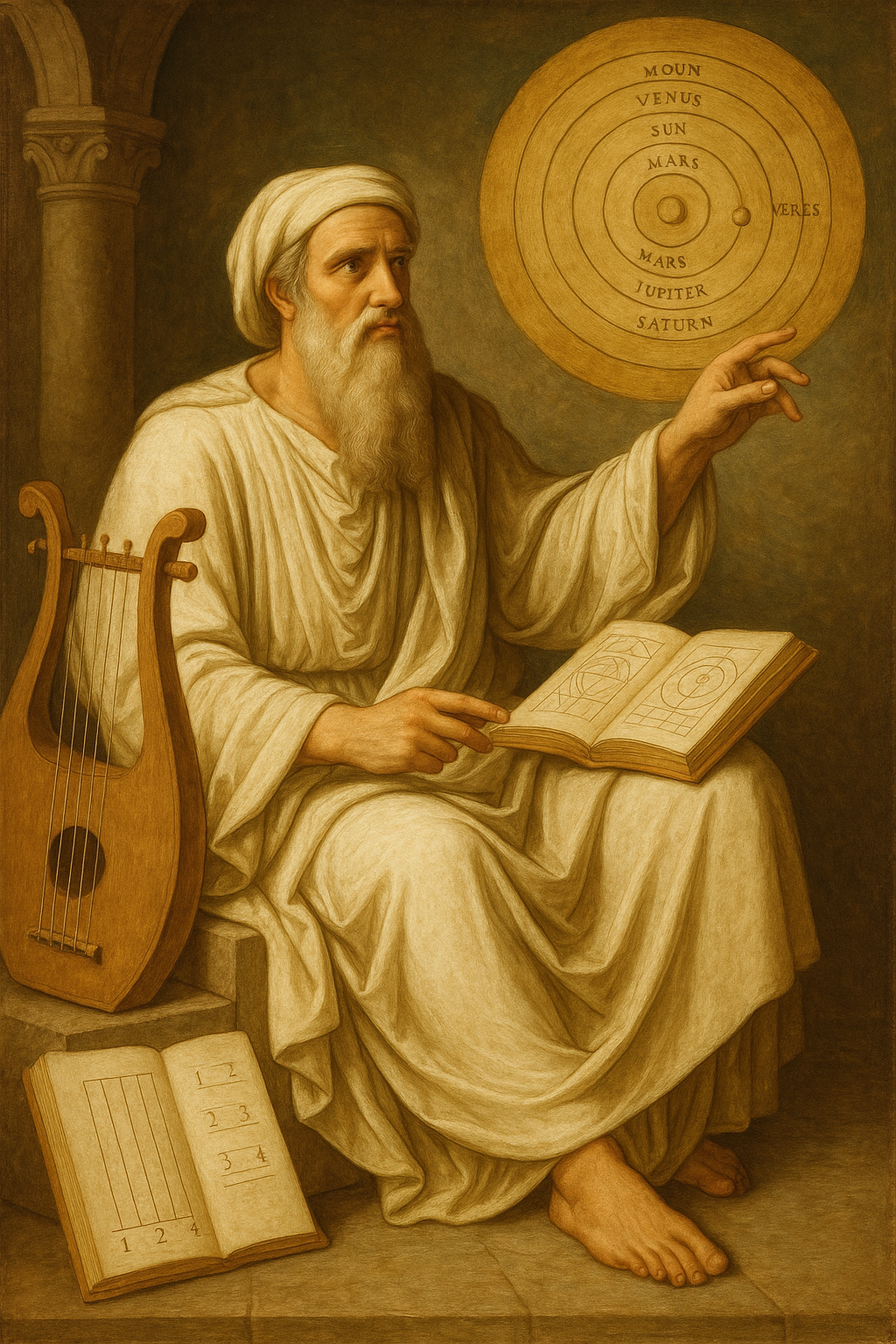
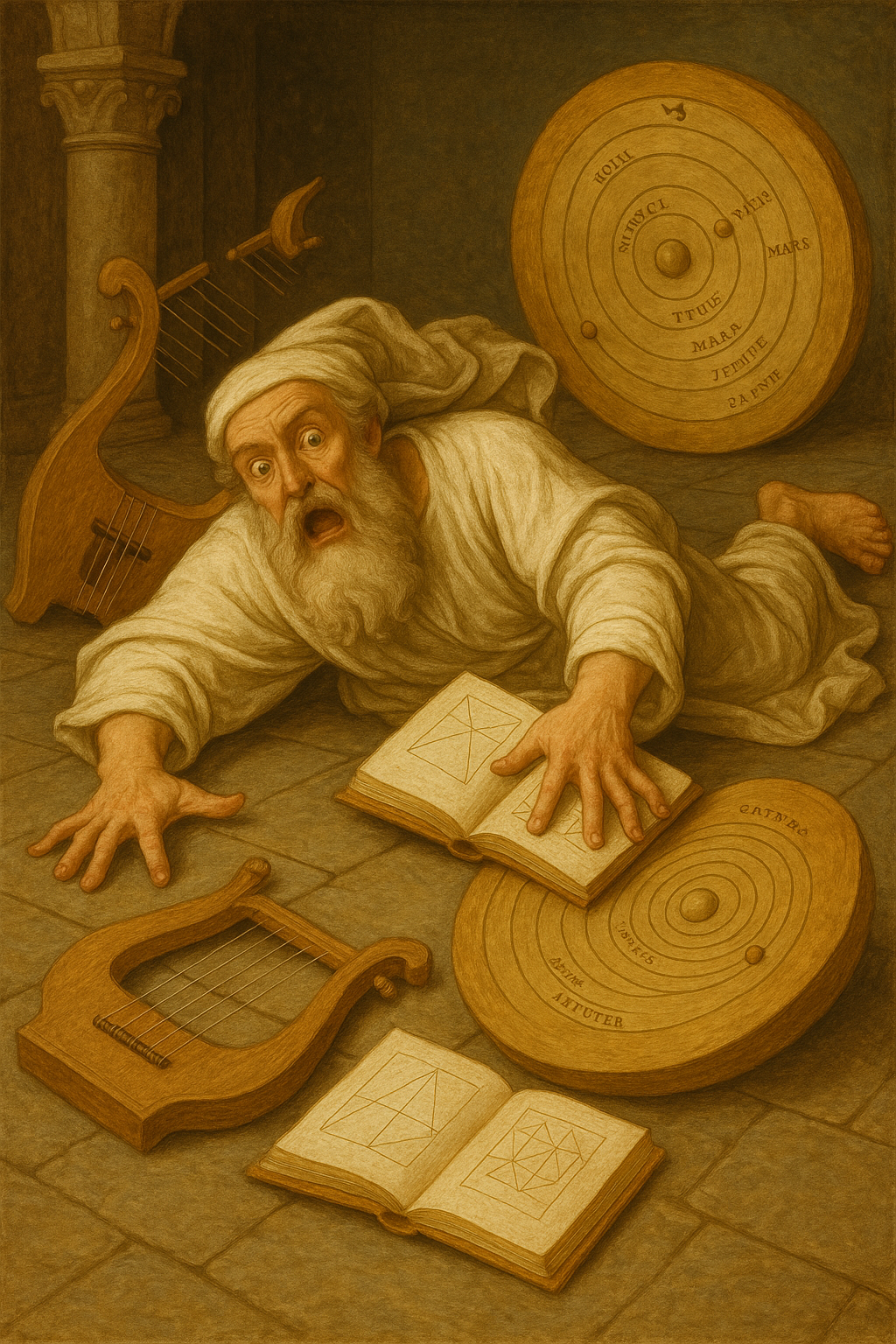
Pythagoras famously discovered that strings that had lengths in a rational ratio produces harmonious sounds. Galileo (1638) suggested that these sounds make the eardrum move regularly, and irregular motion sounds bad. Helmholtz (1863) suggested that tones with nearly similar frequencies produce a beating effect, which sounds dissonant. But he also noted that the overtones giving a sound its timbre also matters.

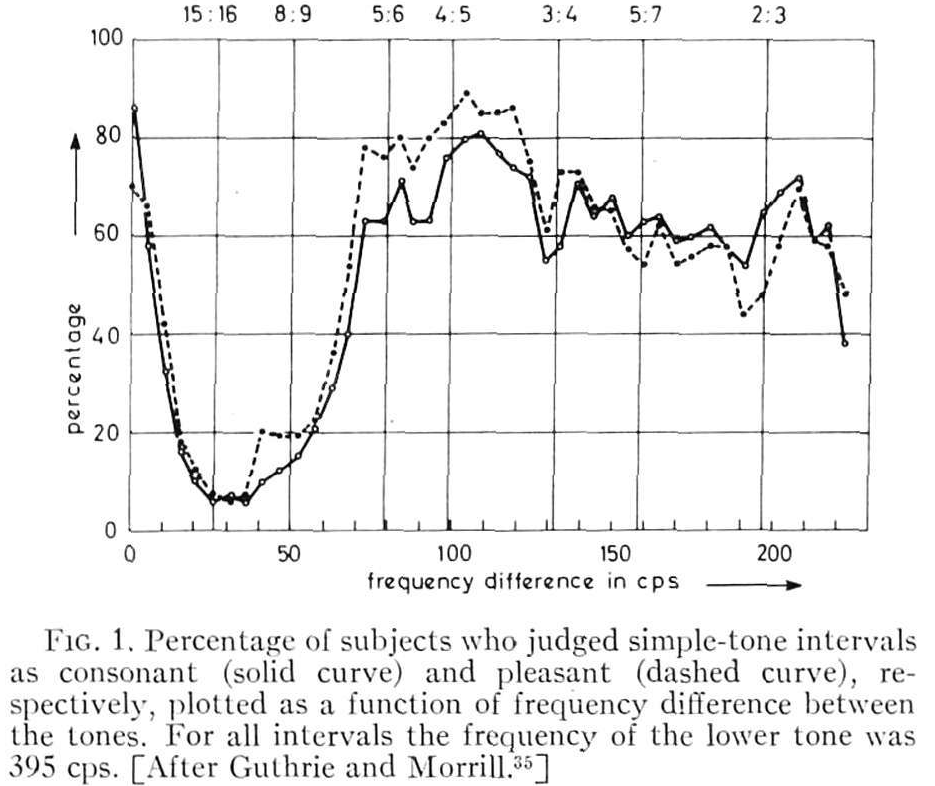
Plomp and Levelt (1965) measured people’s responses to mixes of two sine waves, which produced curves showing how pleasant and harmonious the mixes were. Several models have been built on top of their psychoacoustical work.

The assumed pattern is simple. Unison sounds great, near unison produces beats or (further away) roughness that sound bad, and gradually it turns into two separate simultaneous tones. A kind of uncanny valley.

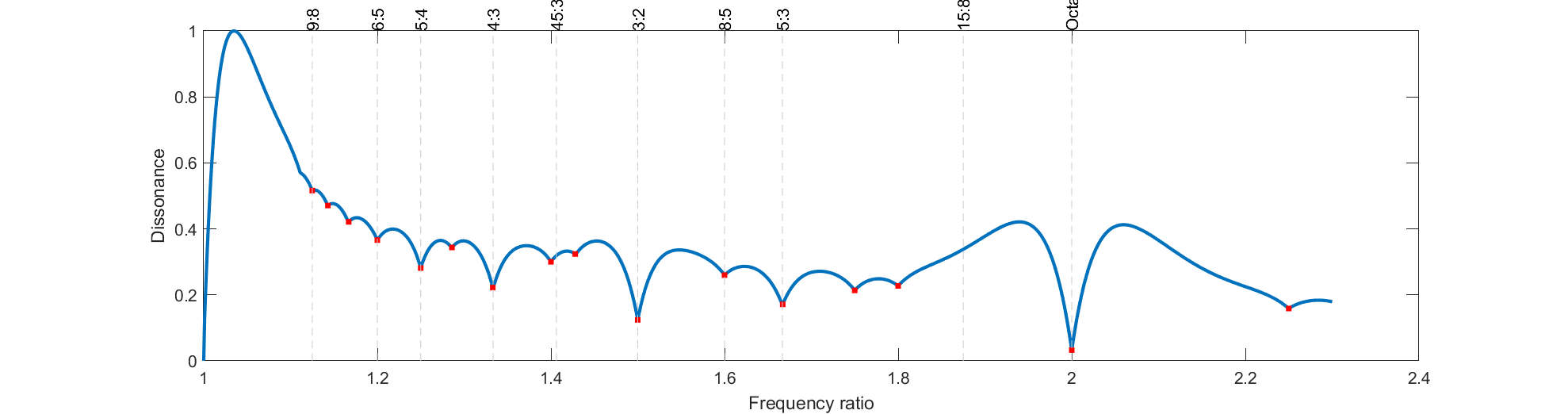
Actual notes have overtones, and these also add to how much discordance you hear (Helmholtz). So if you play an instrument with overtones at 2, 3, 4, 5, … times the root frequency, two notes with different root frequencies will interact through all the combinations of overtones. Some may be consonant, others dissonant. This can be calculated!
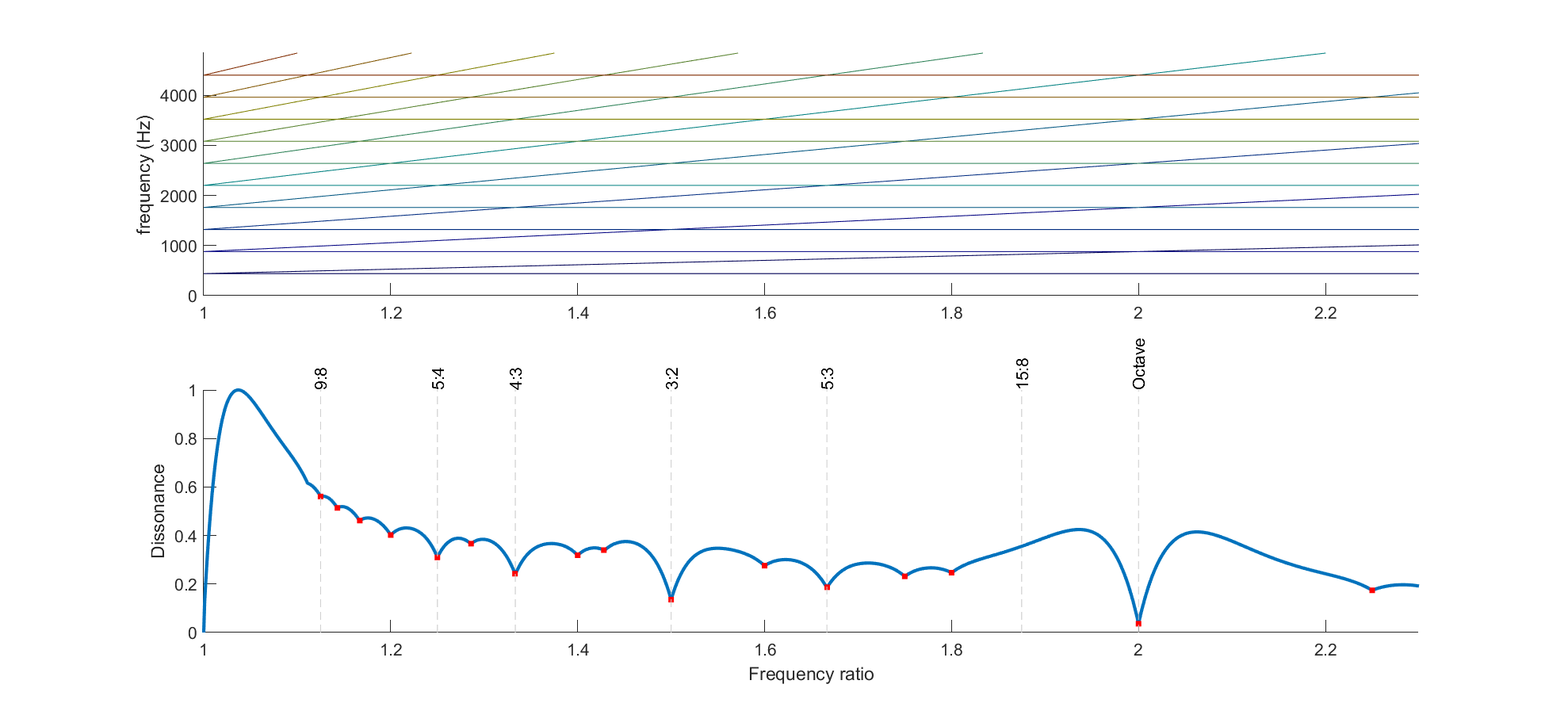
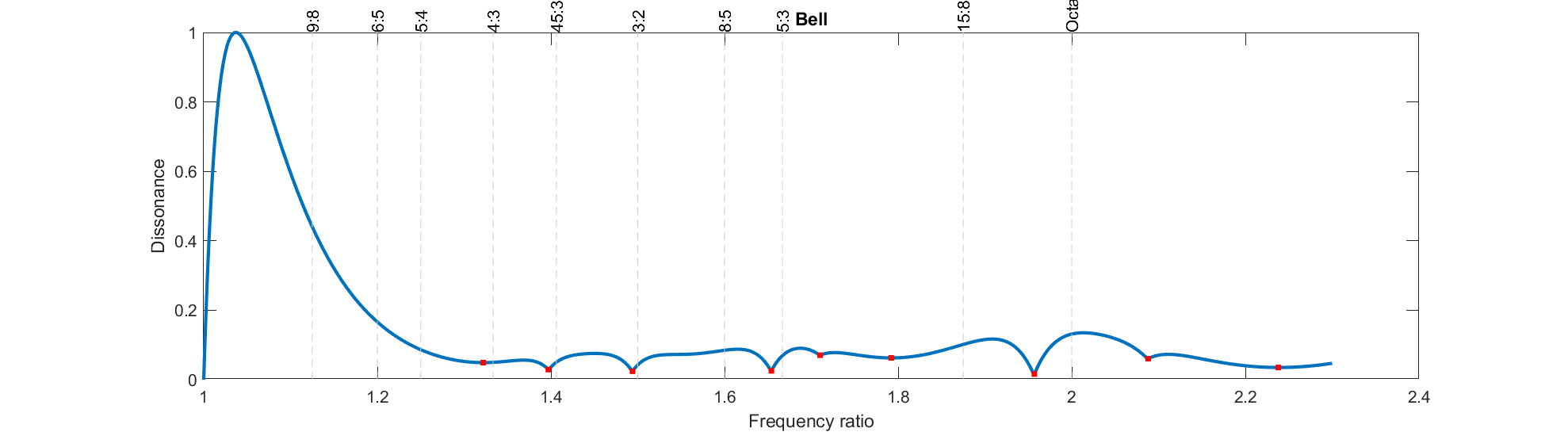
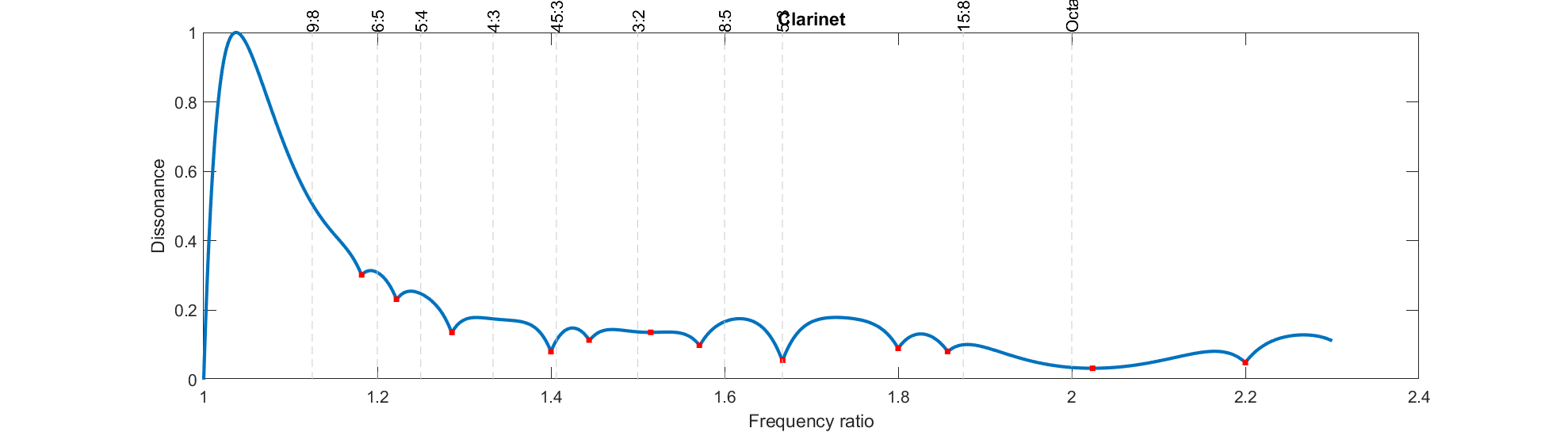
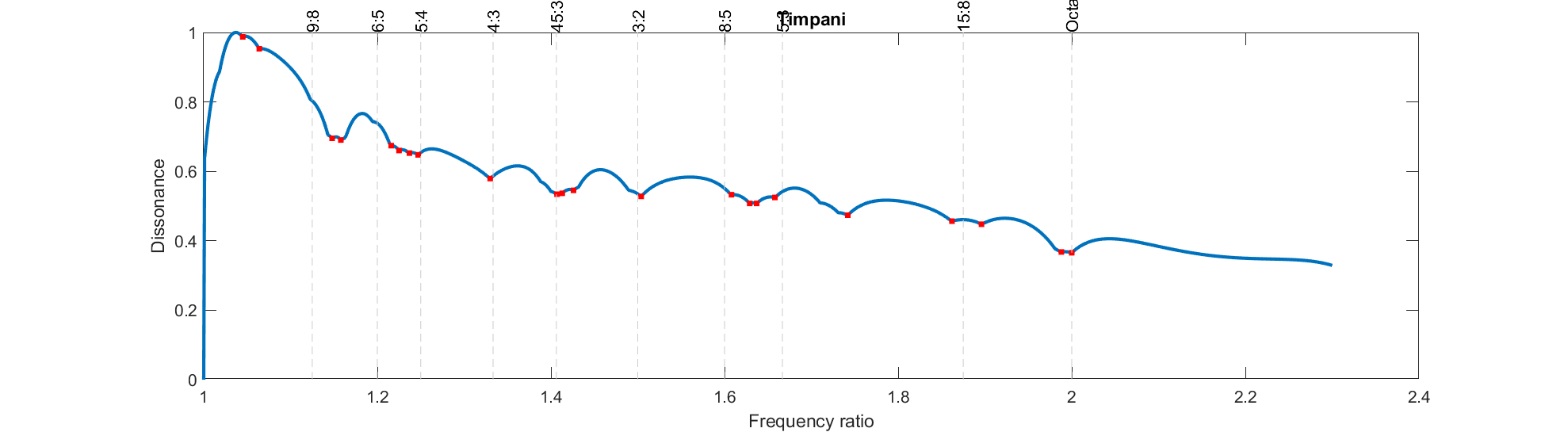
Doing this produces this cool plot. Note the dips (greater harmony) at certain frequencies: this is where all the overtones align. These dips at rational points correspond to the just interval scale.
You can see why the dips occur if we plot the spectrum above the curve. The lines denote the frequencies of the root and overtones of the two tones played: when there are multiple crossings there is more harmony. These correspond in this case to the rational ratios of the root frequencies: not a coincidence!
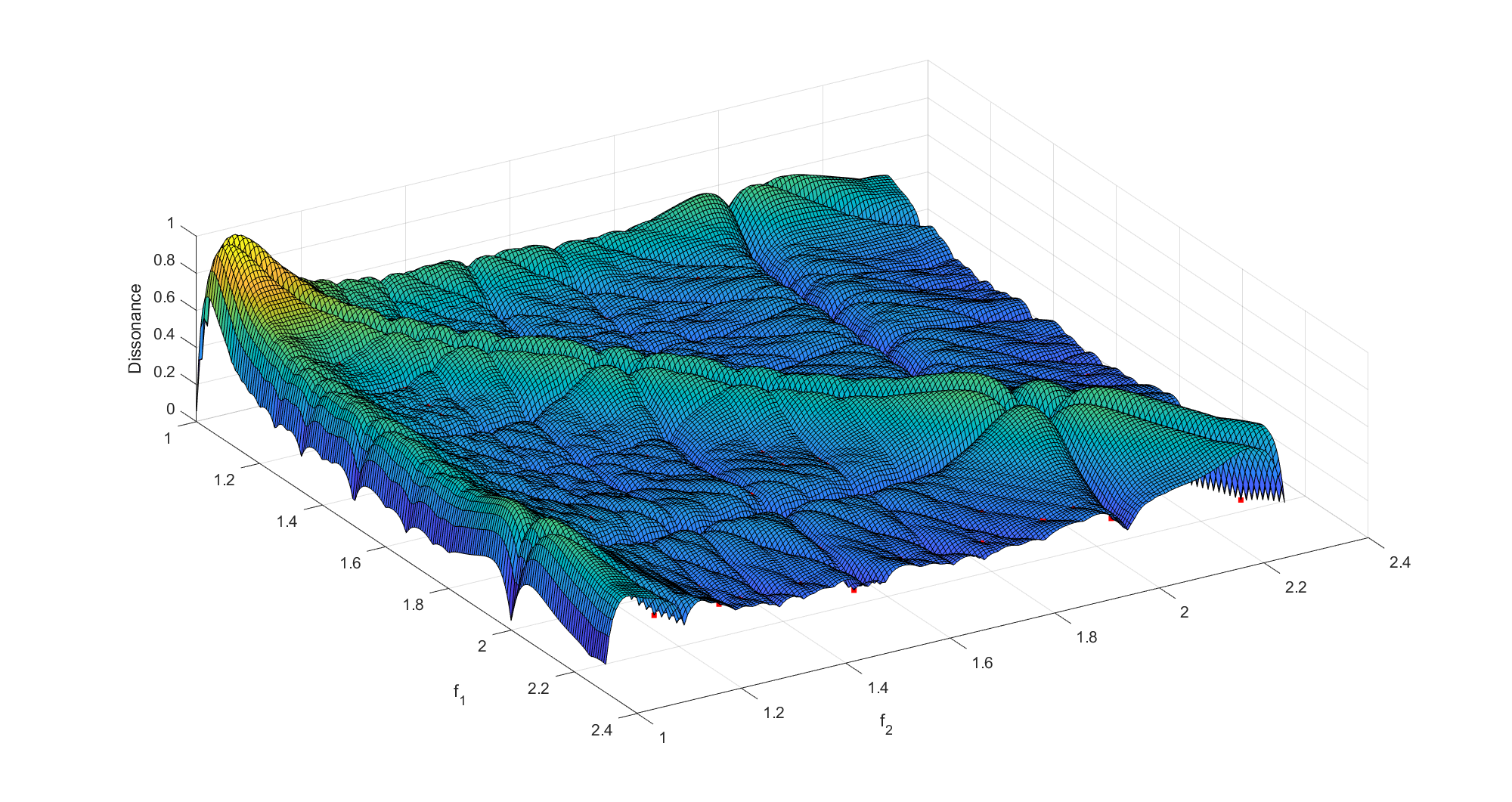
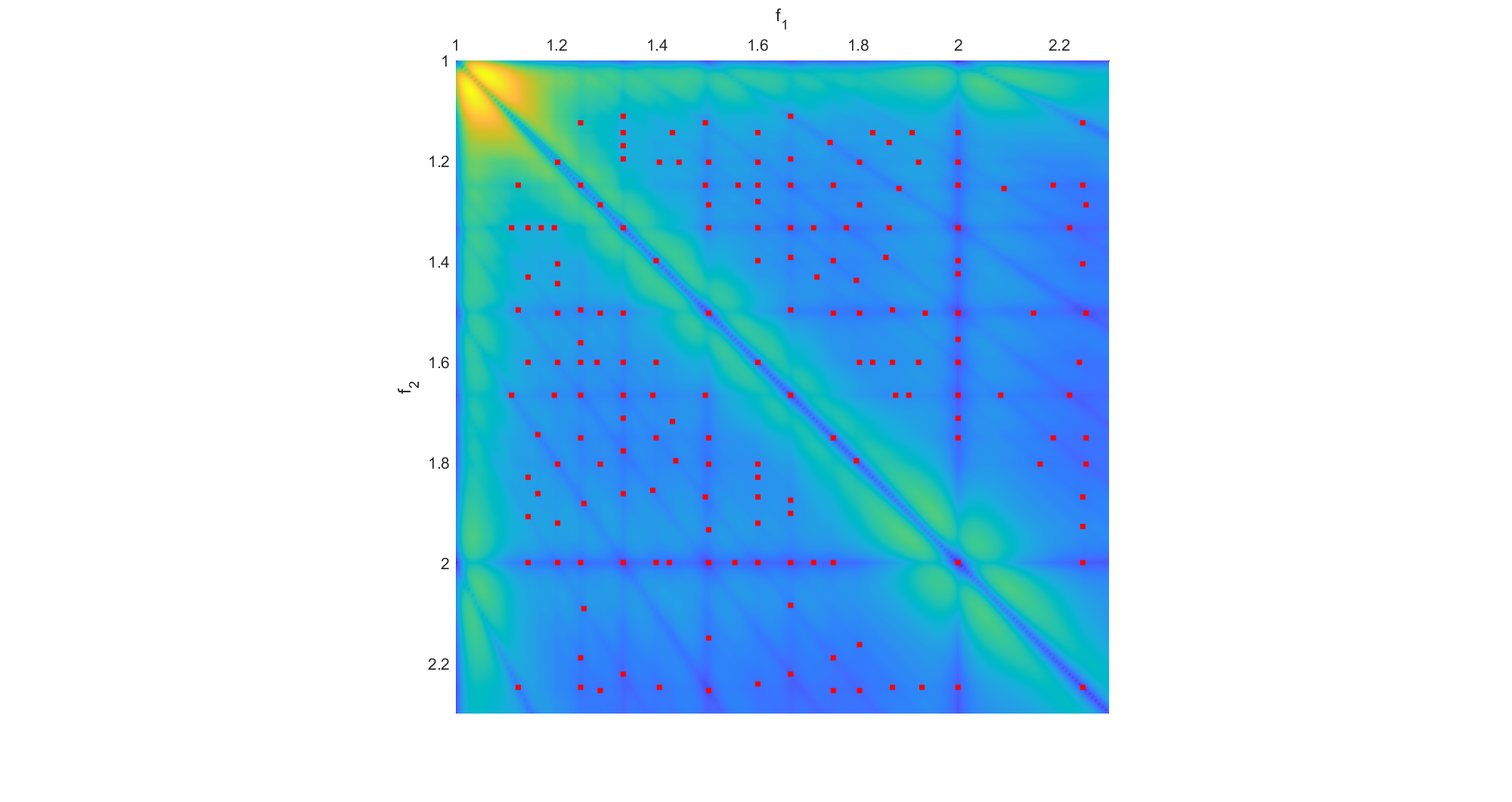
You can also do a 2D plot of the interactions between the notes in a triad.
Plotting the local minima suggests triads that ought to sound good. I have no doubt most of them have established names (I have serious trouble interpreting music-speak). One can also consider chords with four tones, although the visualization becomes more complex.
Universal harmony from math, right?
Hah! In the above plots I assumed that the overtones had frequencies that were integer multiples of the root. This is true for strings and pipe instruments. Clarinets only have odd harmonics. Bells, timpani and bars have different spectrums. These things affect the timbre, how the instrument sounds. But these changes will also change the dissonance curve – making the previous consonance locations change. They no longer correspond to the standard tunings!
So much for the perfect harmony of the spheres!
Bells and gamelans don’t lend themselves to the standard scales (Gamelan also has rather few pitches, which means meshing it with Western scales is troublesome. This produced some of the really memorable parts of the music of Akira soundtrack by Shoji Yamashiro; see this really interesting video analysis of how Kaneda’s and Tesuo’s themes got their character from this.). One can tune bells or bars to fit with a given scale with some effort. In many cultures commonly used instruments have timbres that make different scales sound better. One can also (Sethares is interested in this) take some weird synthesized timbre and figure out scales that work with it.
I also assumed amplitudes declining like 1/n (ideal struck or bowed strings, wind instruments). Plucking goes as 1/n^2, and plucking very near the bridge excites all harmonics strongly (bright sound). The more overtones, the messier the dissonance diagram. But the basic structure remains.
Why I looked into this: I was dusting off an old project about music in universes with extra time dimensions, and wondered if harmony worked entirely differently there. To my delight it looks like the basic scheme is independent of number of time dimensions! Hearing in such universes presumably involves an ear that vibrates like a string or surface, allowing standard separation of variables of the different time dimensions. You get separate consonance for the different dimensions, and demanding notes of the same fundamental pitch to be in harmony forces a Pythagorean triple relation, which produces some very strange scales.
The cool thing about this entire scheme is that the pattern does come from the mathematics of eigenvalues of differential equations. It is not arbitrary. In a sense it is universal to creatures that do not like stimuli that cannot be well separated.
But it should not be assumed to be the full truth. The psychoacoustic assumptions here are only typical: there are plenty of individual variation. Cultural tastes and training differ. Perhaps most importantly, one should not assume harmony is the end-all of music. Music is sound and silence distributed over time, not necessarily harmonious sounds.

Why-chain

By Anders Sandberg

I manifested on a hillside lit by the everlasting sunset, overlooking the dry western plains. A little girl was poking around a tangle of flowers in the terra cotta light. Her clothes were made of felt lizards, quietly and slowly moving around her body. She was manipulating the plants like a well-learned game or a housekeeping task.

She noticed my approach but did not look up from her pursuit: “Hello. What is your name?”

“I don’t have one. I am from out there.” I made a gesture towards the dark eastern sky, hoping she would understand my reference to the Dyson sphere or the wider galaxy.

“I will call you Madenḫu then.”

“What is your name?”

“Today I am Ritsa. Why are you here?”

It is hard to tell what kind of biological one is dealing with. This one was small and looked like a young one, but it could just as well be ancient with a designer body. Or some kind of group mind. I had turned off my omniscience when going here, merely replacing it with perfect intuition: it is impractical to handle the conscious bandwidth and lag of full omniscience when manifesting. So I improvised.

“I am visiting everybody on the world today. I have some news you need to hear. Soon, we will adjust the sphere around the world and the sun. You will have to move or change.”

She did not look up, but continued spooning pollen from a flower into a gooey receptacle of a tubular plant.

“Why?”

“The sphere will reflect differently and this planet will become too hot to sustain life. You will have to become something different, or move somewhere else.”

“No, I wondered why you are changing the sphere.” She gently lifted a small insect from her plant and put it on a dark flower.

Even though I recognized the inevitable why chain coming up, before I manifested I had decided to be truthful and answer everything: “We will make it reflect sunlight in a particular direction so that the system will move.”

“Why?”

“In a long while the sun will pass near another star we have also moved, and they will change course. We are doing it with most stars across the whole galaxy.”

“Why?”

“We are reorganizing it and making it move. Binary stars will be flung past the core black hole and one in each pair expelled, making the entire galaxy move. Other stars will herd the halo so it stays in place.” I was assuming she understood the terms, but how can you tell with a biological?

“Why?”

“We need to move galaxies together into hyperclusters so they are not lost when the universe expands faster.”

“Why?”

“The big forms of mind need to hang together. They cannot do that if their parts run away from each other.”

She did not ask why. Instead she began to move milky sap using a leaf to another plant.

“Why do you have to change this place? It’s fine the way it is.”

I currently did not know why somebody had kept this tidally locked terrestrial around when they built the Dyson sphere around the M-dwarf. Maybe it once had some significance, or it was because of some forgotten aesthetic-financial game. That there was a biological civilization on it had been overlooked until right now. After all, biologicals were mostly on the same level as netlife, but far slower.

“The big plan needs this sun. There are many like it, but it would be hard to move this part of the galaxy without it.”

“But not impossible for you.”

“Probably not. There is some flexibility. But…”

“…we are not important enough. I know.”

“You are important. We want to save you.”

“But you have to do the big things for the big reasons. Small things need to be moved out of the way.”

“Yes. You understand perfectly.” I wished the other inhabitants were as amenable. I intuited that my other selves were having a far harder time.

“Would you save that one?” she asked, pointing at the insect that had returned to the first plant.

“If you agree to dematerialize we can bundle the small animals into the virtuality. If you move or adapt, I guess it will not make it.”

“So you don’t care about moving too small things. How close to edge of smallness are we?”

I did not answer at first. There was no true answer, or at least no true simple answer. Outside, versions of me were having similar conversations with billions of beings on millions of worlds. But I could have tried to talk to trillions of slightly simpler beings on billions of worlds. Or quadrillions of smart things everywhere. The line was more politeness than moral.

“I am closer to you than you are to that edge.”

It was a polite distortion, technically true: me-here was not far from a biological. But I also realized that compared to the big minds the whole of me was probably little more than a smart thing. I would rather be a galaxy held together by politeness than by force.

My intuition told me, somehow, that perhaps we are all small things held together by the politeness of the vast. I did not know what to make of it.