Txamsem’s official flag was decided by the original colony mission (and actually largely stolen from the by-then defunct nation of Kiribati). It has two Haida-style ravens greeting the rising of the sun in a red sky, above the blue and white waves of the sea. After the split of the original polity it is mostly used for rare pan-Txamsem events and by the Council.

Delta Eridani (Rana) has entered the sub-giant stage of evolution. This has turned the former garden world Bright Cloud Woman into a hothouse. But also heated up Txamsem, a major moon of the gas giant Simoighet Mihl that was previously an Europa-like ice covered water world.
|
Squirrel Woman |
Mercury-like rock |
|
Sagapgia |
Mercury-like rock, moon Wa-medi-aks |
|
Bright Cloud Woman |
Venusian |
|
Simoighet Mihl (”The chief of fire”) |
Gas giant with double ring. 39 Moons, major moons are: Txamsem (9000 km diameter, density 1.1 earths, 80% sea, 0.756 G), Coyote (5000 km, 1.3 martian), Xpilaxha (4000 km, 0.7 desert/rock), Lagabula (500 km, 0.9 Martian), Tide Woman (2000 km, 1.0 lunarian). |
|
Salmon Woman |
Iceball |
|
Amala |
Failed core |
|
Kelp |
Asteroid belt |
|
Simoghet Laha |
Gas giant |
|
Ho |
Ice chunk |
|
Forest |
Asteroid belt |
|
Asdiwal |
Ice chunk |
Rana is a variable star, from time to time erupting gas depending on the position of the Simoghets.
Mihl weighs 1 636 times the Earth. Txamsen orbits it every 11.3939023 days, producing sols and nights lasting 136 hours.
The orbit of Mihl is quite circular, as is the orbit of Txamsen. This produces small seasonal changes, but that is largely irrelevant anyway since the day corresponds to an entire period around Mihl, and the random stellar eruptions also randomise the climate.
Txamsen is noticeably ellipsoidal, always turning one pole towards Mihl (the hot pole) and one outwards (the cool pole). The mean radius is 9377 km, but the long radius is 658 km longer and the short is 132 km shorter.
Tidal forces tend to circularise Txamsem’s orbit around Mihl, but orbital resonances with Coyote, Lagabula and Xpilaxha keeps it eccentric. This in turn creates a variation in the tidal bulge that drives an active geology. The crust of Txamsem is divided into ill-defined platelets and volcanic hot spots.
The rotation axis is perpendicular to the Txamsen-Mihl axis, but of less importance due to the small axial tilt; the equator is the circle equidistant from the hot and cool poles and where most of the land exists.
The slow rotation prevents the formation of hurricanes and cyclones, producing a weather dominated by front systems and massive thunderstorms.
The heat balance of Txamsem is complex. In the remote past Mihl was hotter and it is believed that Txamsem was terrestrial – like today, but with far less sunlight from Rana, which was relatively cool. This is when life most likely emerged on the planet. As Mihl cooled a long ice age began and most remaining life survived on the ocean bottom at hot volcanic vents. The world was still warm by most astronomical standards, and it is not implausible that certain photosynthetic algae lived under the ice sheet or in cracks in it. This continued until recently (100-30 million years ago) when Rana began to heat up. Beyond a certain point Txamsem became warm enough to melt the ice and gain a humid atmosphere, heating up further. At present it gains about two thirds of its heat from Rana and one third from Mihl.
At present the climate is heavily affected by fluctuations on Rana. Geological records suggest that brief hothouse seasons and glaciations occur from time to time. The greenhouse and albedo balance of Txamsem shifts somewhat unpredictably from year to year. This has likely given aquatic life advantage over land-based life, leaving most of the dry surface empty. Txamsem climatologists have been suggesting the construction of solar shades in orbit to help regulate weather extremes, but such plans remain futuristic.
In the long run Txamsem will likely overheat as Rana continues to expand. The clouds and large ocean area is a firm moderating force, but beyond a certain heat influx the planet will grow too hot to sustain life.
Txamsem life uses roughly the same amino acids as on Earth, but stores energy as waxes rather than fat. Both ecosystems can eat each other with some digestive problems, but need complements from their own ecosystem. This has prevented escaped animals from spreading. Pure ecosystems are far more stable than mixed ones, enabling the formation of “terrestrial bays” around inhabited islands or in oceanic aquacultures.
Most life on Txamsem is aquatic; land is mostly inhabited by adapted shoreline species like braxenkelp, limoss and squealer bugs. In the ocean vast plankton fields are the source of nutrients for the pelagic ecosystem. Many Mihl-side txamsem plants make use of infrared radiation to a greater extent than terrestrial plants, growing dark purple leaves or heat collector pods.
In the sea major upwellings of cool nutrient rich water near islands or in the open sea produce rich permanent “sea gardens” where algae feed plankton and higher organisms. Swimming filtrators and floating plants like Saragasso hyacinth congregate there, and this is where human aquaculture also tends to gather.
The three most noticeable Txamsem animal phyla are the “sea sausages” (radially symmetric filtering tubes that swim, stay fixed at the bottom or squirm worm-like), the "arachnoids” (exoskeletal radially symmetric 3,6 or 12-limbed creatures) and the
vertebrate-like ultrarays that fill a large number of fish-like and mollusk like niches (many ultrarays can shift between a swimming “fish” form and a sessile “clam” form as part of their development or between generations). The largest animal is the ultraray Reachin Brugd, a massive ray/shrimp-like filter-feeder 30 meters across. An (overly) feared predator is the Shriek-swimmer, a fast manta-like creature with fearsome nose spikes that uses piercing shrieks and jumps in the air to attract other swimmers for hunting or mating. Attacks on humans are rare, and unlike in old sailor tales the swimmer schools cannot sink ships. Another notable group of animals are the bathysps, sea floor dwelling or swimming scavengers with protective spiked carbonate skeletons similar to giant radiolarians. They hold somewhat similar niches to terrestrial urchins, and their empty shells produce vast hollow reefs that are important nurseries for larvae of other species. Bathysp shells are often used in construction as filler or a calcium source for cement.
The deep sea is extensive and ecologically like on Earth: a nutrient-poor, dark world where phosphorescent predators and scavengers vie for scraps of food falling from above. The sea bottom is dominated by the ancient vent ecosystems that most likely were the home to nearly all life for billions of years. They cover vast areas of the planet, mostly inactive but ready to spring into life if the warm water begins to flow. Active vents are surrounded by rich reefs of chemosynthetic organisms, filter-feeders, scavengers and bathysps.
Most plants and animals introduced on Txamsem have been modified to handle the long days. Especially farm animals were modified to be able to graze during the night; the sight of a flock of sheep with cat-like night-vision eyes might be unnerving to offworlders but entirely natural to the inhabitants.
Rather than genetically modify humans in the same way, people rely on circadian drugs to keep themselves healthy and sane. These drugs have been a crucial commodity throughout Txamsem history. During the Time of Shortages the Cartels earned more from selling them than weapons.
Greens are just as vulnerable to the problematic diurnal rhythms as non-greens, although the Alliance has introduced circadian symbionts that produce modulating drugs. This enhancement won over many of the poorer regions from the Cartel to the Pure One side during the worst years.
Txamsem has some environmental problems due to pollution from plankton industry, local ecological disruptions, overfishing and climate effects of major OTEC clusters (environmentalists are promoting land-based nuclear power). Another worrisome phenomenon are blooms of terrestrial microorganisms forming temporary symbiosis-feedback with Txamsem organisms (“blossoms”).
Txamsem lacks hurricanes and rotating high/low-pressure systems. Instead front systems of hot and cool air, as well as extensive groups of thunderstorms drive the weather.
During the long day the air heats up, and during early night rains often occur. Mihl adds heat, making the submihl hemisphere warmer and wetter than the off-mihl (or cool) hemisphere. Along the equator this means the appearance of sudden “evening storms” and the emergence of the feared News Water thunderstorms that drift into the cool sea.
Another particularly Txamsem weather is brigand skies, a risky cold front that brings mist and wind. It got its name because it was perfect for staging ambushes.
The Xie Luang Memorial Array detected an earthlike world around Delta Eridani IV in 2089, and it was named Txamsem after the raven in Haida mythology. It was the first habitable terrestrial world around a gas giant ever found, and briefly aroused interest in the astronomical community.
The first and only colony mission to Txamsem was launched from the L4 shipyards in 2385. It arrived in 2526 to the Delta Eridani system (June 4 is the “official” arrival date).
The Eridani/Kuiper Colony Foundation, a major and diverse foundation, organized the colonization of Txamsem. Their trustee Vincenzo Larinne gained tremendous influence and put his mark on the colony. A refugee from the consolidation wars on Earth he held religion in deep disdain and arranged for the colony venture to be strictly secular.
Txamsem was found to be a highly habitable world, despite the barren land and stormy oceans. Plankton and algae bloom collection enabled the colonists to gather biomass to mulch for soil and process into chemicals. Land settlements were complemented by floating factory farms and later floating cities.
Despite the secular and materialistic society (or rather, because of it) new religious movements emerged. Especially influential was the cosmist movement founded by Pianka Bitt. The cosmists saw the universe as a complex living web of interrelationships where the role of humanity was both to evolve itself and help the rest of the universe to evolve to the higher levels hinted by the “Grand Powers” the cosmists experienced as speaking through nature and science.
As the colony grew and the strains between the pro-secular trustee and the cosmists increased a move towards colonial democracy was undertaken. The new Landfall government became dominated by the “cosmic party” while the “secular party” found itself in opposition.
In 2653 Siki Conlon and her supporter think tanks formulated the “Coyote Plan”, a grandiose terraforming scheme of the moon Coyote. The terraforming debate dominated the 2650’s and led to the creation of several new political formations: the Pro-Reason party (old school secularists), the Raven Party (conservatives against terraforming) and the Coyote Party (pro-terraformers). The cosmists were split between the Raven and Coyote parties, but in the end the majority joined the Coyote side, enabling it a solid long-term majority. During their coalition they began to explore Coyote, map out the terraforming project and implement the first steps. The terraforming was not just to be an ambitious engineering undertaking but also seen as a mystical work to refine the harmonies of the moon system. The strong populist aspects of the project grew increasingly influential over engineering and economic realities. The government promised each citizen large tracts of land on the future paradise, long-term contracts with aerospace corporations and ecotechnologiest grew ever more ambitious and expensive.
In 2695-2702 the entire terraforming project was dragged into crisis. A series of accidents caused an independent study, producing extremely unfavorable data. As more and more people began to question the policies progressively worse irregularities were discovered. Not only did the terraforming itself have unexpected difficulties, but the economy of Txamsem itself was in far worse shape than the government had let on. In fact, the finance department had deliberately misdirected investigations in order to avoid revealing the true state.
The revelations caused a huge public uproar. The re-elections of 2702 saw the old parties loose power to the new Sea Party, a conservative libertarian party advocating stringent budget cuts, an end to the terraforming for the time being and a constitutional reform. The core constituency of the Sea Party was the plankton farmers of the Submihl sea, but now they reached a large part of the population. After their win, they immediately repatriated the terraforming engineers from Coyote and launched an austerity program to curb government spending.
At first popular, the new government soon became the focus of public discontent as entire industries were bankrupted (such as the space industry), government services were cut back to subsistence levels and lawsuits against “profiteers” struck not just corrupt officials but many popular leaders. A change to the constitution enabling a more flexible and small-scale government became the symbolic rallying point for the Sea Party government. But the constitutional referendum in 2706 ended in a resounding ‘nay!’ against the government, putting it at an impasse. Rather than give in to public demands of a less radical politics president Ariani Misak instead announced a change to constitution anyway, a de facto coup by the government. It set out to curb resistance to the harsh but necessary reforms ruthlessly, causing the opposition to take up arms. Over the next few years the government became known as the Authority (short for “The Lawful Authority of the Eridani/Kuiper Foundation Txamsem Settlement”) and a symbol of oppression to the rainbow alliance of cosmists, anti-authoritarians, terraformers and enraged citizen that struck back against it.
The civil war of 2706-2708 ended with the sacking of Landfall. The Authority imploded, but by now the crisis was so serious that the rebel coalitions could not agree on any solution. The approach taken was to divide Txamsem into a number of independent regions and hope that individual regions could find local ways of saving themselves.
During the “years of hunger” marauders and pirates plagued Txamsem. Cities and islands became de facto states, warring against each other for resources. Over time a number of alliances and movements began to crystallize.
One was the Hansate, industrialists and traders selling weapons, medicines and other necessities. Being in need of defense they built their own navies and armies, banding together into a trading federation against marauders and competitors.
Most cosmists were strongly anti-violence, making them victims of marauders and others. As a response a militant branch of cosmism emerged, The Enlightened, seeing the defense of others and the evolving cosmic order as karmically acceptable. These radicals grew in influence, eventually dominating most of the cosmist settlements (forcing them into the growing “Cosmist Alliance”) and holding their own against the marauders. They formed a military priest-nobility with its own strict ideals, supported by the feared Shark Troop elite warriors.
As disorganized pirates were picked apart by the emerging alliances the marauders themselves began to organize under the leadership of the legendary Miss Chief. Her campaigns against the cosmist are the stuff of Txamsem legend, a mixture of brilliant tactics, underhanded trickery, inhumane cruelty from both sides and moments of enlightened clemency. Her poisoning of the Sorrow Islands through organo-iodine compounds in fertilizers still have noticeable ecological impact and led to the Sorrow War. An outraged Alliance attacked the key pirate settlements and factories at the submihl pole to reach her. Miss Chief ended her career by using herself as a bait as she used her stock of nuclear weapons to wipe out the attacking fleet, her own core bases and herself, guaranteeing her a permanent place in history and personality cult.
Meanwhile the Hansate had become embroiled in war against the expansionist Citadel, a state claiming to be the inhereitors of the lawful planetary authority. Their long-running campaign against the Citadel involved both the Alliance and mercenaries from Miss Chiefs disrupted “pirate kingdom”. These mercenaries were led by Iri Khansyyk (usually called “Greenbeard”), her successor and by far the most feared and brilliant naval tactician of Txamsem history. As the war slowly pushed back the Citadel the inflow of Hansate money enabled Khansyyk to build up a sizeable infrastructure of his own, the sea nation of Shanegould.
Slowly a new political order emerged from the chaos of war and poverty. As the Hansate, Alliance, Citadel and Shanegould stabilized the economy prospered.
The re-introduction of air transports led to a communications revolution linking the nations together. It also led to the formation of the Air Council, the closest thing to an UN on Txamsem. Originally just a joint meteorological and airplane standards body it grew to a meeting place between the nations representing all of Txamsem. Its political power remains limited, but symbolically it is a key institution showing that Txamsem is again a functioning world.
In 3010 the people rose against the Enlightened of the Alliance in a brief and bloody revolution, later called The Sudden Revolution. With outside support the militant cosmists were ousted and their apparatus of state dismantled, replaced by the profoundly democratic new alliance. The revolutionary leader Maria Kaleni became president and begun a program of modernization and openness that reverberated across Txamsem.
The Citadel, always eager to demonstrate their technological and national power, achieved spaceflight in 3019 and manned spaceflight in 3025. Together with Hansate investors they began an ambitious “reclaim space” program from their enormous floating city Behemoth. In the Alliance biotechnology flourished thanks to the development of biocomputers.
By 3110 Txamsem was fairly prosperous, mostly peaceful and progress oriented. That year interstellar contact was made: a starship entered the system, radioing greetings from “The Web of Worlds”, inviting Txamsem to join the FTL-linked community of mankind. It began to transmit information about this Web when it was suddenly destroyed by fighters of alien construction erupting from the clouds of Mihl. An alien starship rounded the planet, transmitting warnings against contacting the Web.
The Aerospace Council sent a diplomatic team to the aliens. After some initial negotiations and misunderstandings the situation became clear: the aliens (calling themselves ‘Egoi’ in human language after selecting the name apparently randomly from an information database) were the survivors of an incursion/attack by dark matter creatures (“the deep darks”) that had forced them to destroy most of their civilization. Since then the Egoi had built an interstellar community with some other species, always on the lookout for deep dark incursions. Now humans had likely made contact with the deep darks and come under their influence through their use of FTL communications: the Web of Worlds was, according to the Egoi, likely a beachhead of the deep darks using humans as puppets to conquer the galaxy. The Egoi offered the governments of Txamsem technological support and information in exchange for help in understanding the Web and if necessary, dealing with the deep darks.
Txamsem is divided into four major nations/powers, each consisting of a number of smaller polities, districts or communes. With the exception of the Authority the powers are relatively unbound by geography. They have settlements in many places, connected by the sea and plane, and mobile sea habitats that travel depending on weather and ecology.
At present the major powers are:
The Hansate |
Originally a cartel of arms manufacturers on Twolight Island that later expanded into a mercantile imperium. Still the pre-eminent economic power on the planet although others are catching up. Ruled by the Peers of the Upper and Lower Cartel. Capital Chrycu on Reisen. Major cities: Mondiu, Helffrich, Herkalanding, Borosa, Landfall and Windy Deed Gulf. |
The Authority
|
A fiercely traditionalist and nationalist nation on Citadel Islands. Claims to be the rightful continuation of the original planetary government. Authority culture is authoritarian and militaristic, bordering on classical fascism. The Authority operates the Behemoth: a massive artificial island used as the main planetary launch site and a military and transport hub. Main Citadel island-city states: Citadel, Rözov, Salavat, Tell City and Living Rainbow Gorge. |
The Alliance
|
The widely flung Alliance unites cosmist-run states and habitats. After the Sudden Revolution it is a scrupulously democratic state valuing transparency highly. The heartland lies near Clari Peak, although Ace Islands and Sorrow Islands are more populous and the Alliance has extensive sea settlements at the Submihl pole. There is no permanent capital after the Revolution, but it rotates between the 9 major districts on a schedule. The districts are: Sunrise (named after the Sunrise Wetlands), Monkey's Fort, Sorrow Islands, Submihlë (floating cities and islands on Western hemisphere), Ace Region, Youside, Ubefloat (floating islands on Eastern hemisphere), Ruddybanks and Southray. |
Shanegould |
Ambitious, expansive and decentralized, Shanegould is the only purely sea-based nation. Major cities are: Poseidon’s Landing, Ozökat Central, Unzold, News Water Patrol, Waveseek, Leonid Float, Iceberg Three, Hangamanna Howl, Liberator Dawn, Silent Eye and The Sacred Nomad (a cosmist floating city). |
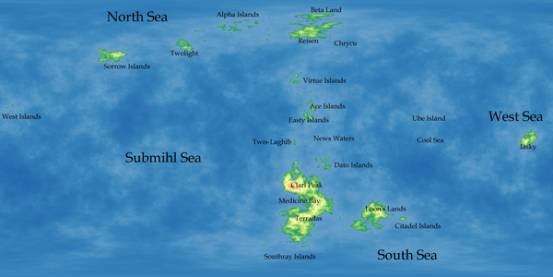
Txamsem have six poles: the north, south, east, west, submihl (warm) and cold poles. The submihl pole is the point which is closest to Mihl, the center of the submihl ocean. On the opposite side in the cool sea lies the cold pole. The rotational axis marks the north pole The eastern pole lies south of Easty islands, while the west pole is near the West Islands group. Usually “the equator” refers to the circle through the north, east, south and western poles rather than the ellipse orthogonal to planetary rotation. Most land lies relatively close to the equator
The largest landmass is Clari-Terradas in the southern hemisphere. It is mountainous mini-continent surrounding Medicine bay, formed as a volcanic hot-spot. The highest mountain on Txamsem, the Clari massif, dominates the northern third of the landmass. On the north side lies Harbor of You, a major Alliance port and transport hub that is the capital of Youside region. The middle part around Medicine Bay (often just called “Medicine”) is still dominated by the imposing government temple edifices from the pre-revolution days. They have been privatized or turned into homes, creating the very distributed “government city”. The south part of the landmass is Terradas, the Alliance breadbasket.
South of Clari-Terradas lies Southray islands. Popular for their cool weather and dramatic aurorae among the cosmists, they are filled with retreats, hospices and ashrams. Most famous is the Water of the Holy Giants cave complex on Köprenë.
East of Clari-Terradas lie Loon’s Lands, a group of similarly mountainous islands and archipelagos stretching east to the steep Citadel Islands, home of the Authority. The main city, Herkalanding, is one of the few Hanseate cities on the southern hemisphere. The River of the Fools is the longest river on the planet, home to the only salmon colony on Txamsem.
Northeast of Clari-Terradas lies the Dato Islands. Formal allegiance is very mixed, and the Datoese have a somewhat cavalier attitude to citizenships.
In the equatorial zone near the eastern pole (“news waters”) lies the island Twis-Laghib, the Easty Islands and Ace Islands. North of them lies Virtue Islands. This is also a region of very mixed nationality, shifting from island to island or even on the same island. Notable cities are Mondiu (Hanseate), Ruddy Banks (Alliance) and the permanently anchored Unzold (Shanegould). Here lies also the main independent nation, Sheep's Skull Chapel, named after the capital (in turn named after a church on the peculiarly shaped mountain). Sheep Skull remained independent throughout the Time of Troubles, largely through creatively misunderstanding invading fleets.
The cool sea is mostly empty, with the exception of Ube Island and the Koke Reefs. Near Koke lies the Shanegould major city Ozökat Central, (“Camp of the Central Cats”), one of the most independent cities.
The west sea has the large island Iasky and the West Island archipelago.
The north sea is dominated by a chain of islands stretching west and submihl. Westernmost lies Sorrow Islands, east of which lies Twolight. Twolight was the original location of the planetary government and the city of Landfall is located near the centre. Sorrow Islands have recovered from the ecological damage brought by poisoned soil during the Time of Troubles but still remain the centre of the fiercest cosmist protectionists within the Alliance. The region is a mix of hansate and alliance settlements, with Shanegould plankton factories anchored off-shore.
East of Twolight lies the Alpha Islands archipelago, stretching towards Beta Land, the northemost landmass on Txamsem. Just south of Beta Land lies the major island Reisen. The city Chrycu on the southern side of Reisen is the Hanseate capital. This is Hanseate heartland, although there exist a few Alliance enclaves and many Shanegould off-shore settlements.
Txamsem languages are all descended from the orbit-style English of the Second Renaissance that developed up until the Bad Times. During the later period it diverged into a number of related but different languages. Recent growth in international communications and commerce is melding together them again into a general Txamsemese language with local variations.
Main dialects/languages are Terradese (spoken in Clari-Terradas), Mihlese (the official Shanegould language), Balandë (around News waters), Nortner (northern hemisphere islands) and Ube (cool sea). People can understand each other, but pronounciation and grammar sound strange and there are a number of “false friend” words that confuse (in Nortner “klear” means being good, efficient and obvious, while in Terradese it means being empty, useless and shallow).
Txamsemese is written using an extended English alphabet adding vowel tones and a few variant sh-sounds: Aäbcdeëfghiïjklmnoöpqrstuüvxyÿz
W and v have melded together to the same sound
In general Txamsem people have a first name and a family name. Name origins are mixed from across Earth languages, but Western names contribute about 75% (despite the settlers being a more even mix).
The family name is not uncommonly a place designation: deGrenbank, of Oren, Salmonbeach. The use of location prepositions like ‘de’, ‘von’, ‘of’, ‘van’ etc. is fairly inconsistent and usually selected for good pronunciation or ad hoc from day to day.
Many Hanseate families have names linked to an Earth location. During the growth of the Hanseate there was a fad for finding terrestrial roots of the newly rich families, resulting in a thriving business of genealogists. They used old records and plenty of clever explanations to find the “origin” of people to particular Earth locations, and often the family took the location as their new family name. This resulted in family names like Voronesh, Vaxsjo, Nevyork and Tajvan. Over time the names spread, becoming woven together with the family mythos about the origins of the family and why it left Earth.
Some common female first names:
Alia, Alistef, Anne, Ata, Bet, Couresa, Deatina, Demeda, Dia, Dorine, Eudori, Eri, Jana, Jene, Joandra, Julie, Jusan, Justene, Karcia, Katrick, Kiku, Laure, Line, Lorissy, Maranet, Marina, Marthar, Mayoria, Mica, Nanna, Nathird, Pandra, Racy, Sherist, Shia, Siki, Scemena, Sylvia, Tariett, Tiferin, Tiffanc, Xania
Male names:
Agateli, Ajay, Alejan, Alen, Alfo, Alfonio, Amenge, Antebal, Anthan, Antiago, Ashiray, Asundah, Ath, Bennis, Benys, Brey, Bricart, Bry, Chris, Chuck, Davin, Dene, Dev, Devekna, Dhigele, Donny, Douge, Duandro, Dulio, Edwarry, Feodorg, Fro, Gardo, Garo, Garry, Geo, Geor, Giano, Gris, Gundo, Gundro, Gute, Hermeno, Iakovus, Iandes, Ianos, Isidore, Ivan, Jack, Jamin, Jannagi, Janos, Jason, Jasony, Jeff, Jeffrem, Joa, Joe, Joel, Jon, Jos, Justoph, Keithen, Ken, Kenryan, Kishara, Krions, Krios, Kyprila, Leodoro, Mathuce, Meno, Mictaia, Nat, Nict, Niranja, Orios, Osorgil, Paren, Parista, Pedresi, Phillia, Polos, Pra, Ranan, Ratamsu, Rathash, Rayne, Roben, Rodo, Rodrist, Rohinat, Ross, Ruben, Ruber, Rustoph, Sames, Sankai, Scot, Sebas, Sesco, Shane, Srish, Ster, Stert, Stewa, Stuan, Telos, Theoder, Thon, Titamas, Tomas, Vasukum, Velipe, Vic, Victoph, Vido, Yan, Yotik, Zace
In general Txamsem has a mid 21-st-century technology basis. It has a strong biotechnology and chemical industry, including ecological management and manufacture of soil for land farming.
Txamsem is quite advanced in coolant systems, used in everything from air conditioning and refrigerators to liquid hydrogen storage and pycrete.
Information technology is less widespread than on old Earth, but still relatively common. Many devices are run using flexible polymer or biotech computers, especially green biocomputer sheets (photosynthetic neurocomputers).
Space technology was developed independently on Txamsem and is a matter of fierce pride for all, especially Citadel islanders.
Since Txamsem land largely lacked topsoil and there were no petrochemical reserves the colonists began harvesting vast amounts of plankton to produce the organic chemicals they needed. Sea harvesting ships or aquafarm gather plankton, which is then decomposed or treated at floating chemical factories to produce hydrocarbons, waxes, proteins and all other kinds of chemicals. Mulched plankton with salt removed is used as fertilizer and artificial topsoil, a major export of the Submihl sea.
The Greens are not a true sub-species, but rather humans that have adapted to living with a photosynthetic symbiont in their skin. The symbiont (“the green knight”) is a photosynthetic endobacterium that thrives in dermatocytes, producing sugars, amino acids and oxygen from urea, carbon dioxide and sunlight. Knights are not efficient enough to replace feeding or breathing significantly (the energy efficiency is about ~0.5% in direct sunlight at best), but can contribute to nutrition and helps prevent sunburns. They are inherited from mothers by children, making the symbiosis and variations of it heritable. The green knight was developed more as an idealistic symbol of life-integration by the cosmists than a practical enhancement but it has become the defining factor of a strong subculture on Txamsem.
Using special dermal enlargement treatments the Greens form patagia that helps enhance photosynthesis, swimming or just act as fashion statements. Greens seldom wear clothes, but use dermal enlargements for protection and modesty.
Having the green knight affects the immune system in somewhat unpredictable ways. In a few percent of the Greens it causes occasional autoimmune reactions. A more serious effect is uncontrolled replication in neural tissue (where it is purely parasitic) where it can trigger reversion of neurons to neural stem cells and subsequent replication. Such “green brain tumours” have been linked to various mental aberrations and neuromas, but also led to the development of “green biocomputer sheets” on the Alpha Islands that led to the Txamsem technological revolution.
A notable variant of the Greens was the feared Shark Troops of the Pure One Alliance. These elite marines emulated their totem not just through military ferocity, but also through implanted/modified teeth and the practice of cannibalism. Although military cannibalism extended beyond the Shark Troops during the worst parts of the Starvation Wars it was the Sharks who introduced it and made it a psyops-sacrament. After the revolution many adherents to the Pure One ideology and especially the Sharks went underground and fled from the Alliance. While the Shark Troops most likely are entirely gone they are a favourite of Txamsem conspiracy theorists and military buffs. From a biological view they were nearly identical with the ordinary Greens, but some experiments with battle-drug producing symbionts are documented.
Egoi technology is appearing here and there, mostly in a number of government projects. The big Aerospace Council Research Committee (ACoRC) is officially handling human-Egoi technology exchange, but much of the committee work is handled by individual research institutes like Greenbay University and Krekö Institute of Technology. In addition, each of the four governments have their own Egoi program and the Egoi are even liaison with some individual companies – the Hansate Technology Exchange Bureau is doing its best to keep checks on Muruk Corporation, and the other three nations are equally annoyed.
Mindstate technology is new, experimental and somewhat risky. Similarly making android bodies is still confined to major projects like the AcoRC Orgoculture consortium.
Ice ships and platforms are commonly used. By mixing water with a binder it can be turned into a strong composite (“pycrete”) that melts slowly, floats, resists impacts and is very cheap (on Txamsem various forms of algal waste are used, giving pycrete a greenish tinge). The surface becomes covered with the fluffy binder, insulating the ice beneath. Large blocks can be created, and then sprayed together with supercooled water. In some permanent constructions coolant pipes are installed keeping them stable, but more commonly freezer teams simply go around adding more blocks and ice where needed.
Another common building material far from the shore is seacrete. Seacrete (or seament) is electrodeposited: a wire mesh is placed in the water and powered using solar cells or other electricity sources. A solid concrete like accretion forms as calcium carbonate, magnesium hydroxide and salt accumulate on the wires. The more slowly it is accumulated the stronger it is. Builders measure the strength in time; “one year seacrete” is the highest quality, more than twice as strong as ordinary concrete, while “one week seacrete” is mainly for decoration. Some seacrete projects also add hormones to stimulate marine organisms to grow on the surface, producing floating reefs with huge surface areas. Once enough seacrete has been accumulated the current can be turned off and the wires left in as bracing or sensors. In Shanegould seacrete is the most common building material, often combined with composite or plastic sheeting.
Txamsem lacks useful petroleum reserves.
Most of the ocean settlements are powered by OTEC plants, exploiting the heat differences between cool deep sea water and surface water. As an added bonus, in many locations plants can be used to pump nutrient rich water to feed artificial algal blooms that in turn feeds aquaculture. This is the key to many of the sea settlements.
Collector film is used to collect solar energy. It is a flexible grey-blue plastic film that produces electric current on its contact borders when subjected to sun- or Mihl-light. It is cheap, not very efficient but can be used for cladding roofs, boats, sails and anything else to accumulate energy. Especially in the Submihl sea there is always some infrared power to be harvested, making collector film practical to drive equipment.
Floating scraps of collector film is usually a sign of poverty - badly repaired buildings and equipment, little environmental effort. Larger pieces of film can pose a fire hazard: they drift in seawater electrolysing it, and if they end up in an enclosed or wind-free space they can produce a local concentration of oxygen-hydrogen that could ignite.
Most of the sea settlements and quite a few land settlements store and use energy in the form of hydrogen, produced by electrolysing seawater with electricity from a power source and then used in fuel cells. Even low-efficiency sources like collector films can produce useful amounts of hydrogen with minimal supervision. The hydrogen is these day stored in artihyd, an “artificial hydride” quasimetallic compound that can absorb and release hydrogen without being too heavy or a fire hazard (if heated it will release hydrogen that will burn hotly and invisibly around it; sometimes artihyd bricks are used in fireplaces to heat up metal rods that radiate warm glow)
Major ships and installations use cryogenic storage tanks – efficient with modern cooling technology but also explosive if broken or subjected to fires.
Txamsem culture is diverse, and inhabitants can usually easily tell if somebody is from submihl Shanegould or the equatorial Hansate islands by speech, clothing or behaviour.
Alliance inhabitants, especially those living in the more comist parts gesture in a particular way. They make mudras with their hands as part of everyday speech, and often their gestures convey as much meaning as what is actually said.
The cosmists invented a martial arts school known as The School of the Great Fires. It is relatively well known but only taught in specific schools on Terradas. This martial technique has a popular reputation for discipline, and is virtually obsessed with etiquette – to a large degree it is more of a social martial art than a military one. Practicioners form a kind of Masonic network of mutual recognition and respect that is said (at least by the paranoids) to be holding powerful positions economic and political within and outside the Alliance. The Great Fire School was a key component of the old militaristic Alliance order and hence it is somewhat “politically incorrect” these days, but it still attracts many people through its promise of order and discipline in a changing world. The "Defensive Flame Guard Katas" are still ritually performed by the adherents in Medicine Bay each eclipse.
Citadel inhabitants are more guarded and quiet than their neighbours, but often display fierce nationalistic pride whenever they can.
“The Azure Realm of the Dead” is a common story, telling how the dead live in a secret world under the sea. There they watch over the surface dwellers, sometimes sending signs or blessings, sometimes attacking them with storms when their behavior irritates them. In the story a young boy and girl find their way down to the realm. The main plot deals with how they finagle their way in and out of the palace of the Grandfather of Blue to steal back the wedding band he took from their parents.